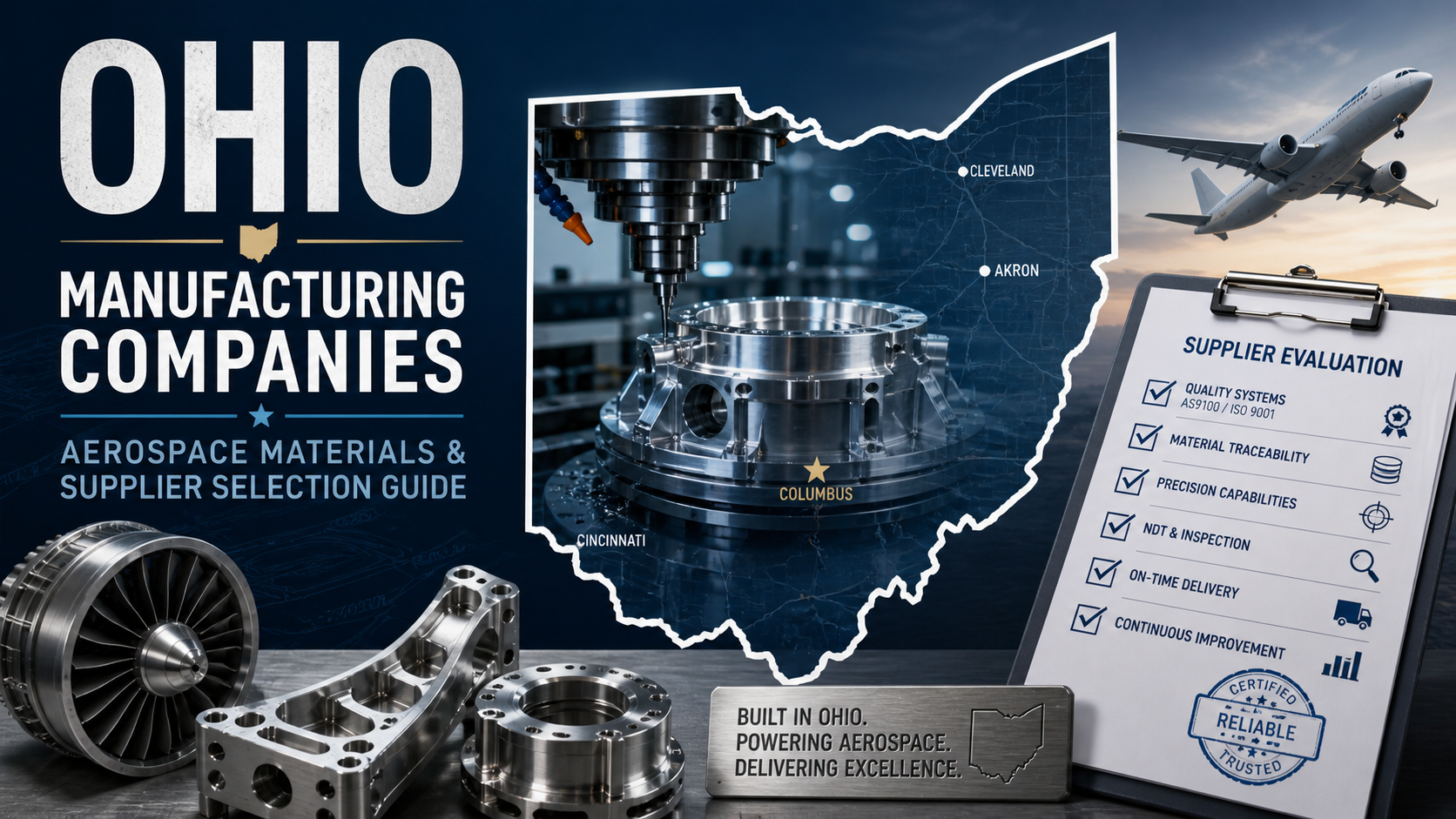
A buyer-memo guide helping procurement teams evaluate Ohio as a U.S. domestic sourcing region—focused on what capabilities actually exist and how to verify supplier claims before committing a purchase order.
TL;DR
Here's the practical way to shortlist Ohio manufacturing companies for your aerospace or precision component project—without wasting time on unqualified suppliers.
When you're evaluating Ohio as a sourcing region, what actually matters is:
1. Process capability match between YOUR part and their equipment
2. Whether they hold relevant certifications (AS9100D/ITAR if it's defense-grade)
3. Real-world track record with Tier 1 buyers—not just marketing claims
4. What documentation they're willing to share before you commit a PO
This guide walks through what the evidence actually shows about Ohio's manufacturing base, where supplier claims get overblown, and the specific shortlisting questions that separate qualified suppliers from time-wasters.
Why This Matters Now
The domestic reshoring conversation has shifted from "should we?" to "where?"—and buyers are looking at specific U.S. regions with real manufacturing capability rather than generic "Made in America" promises [1].
Ohio occupies a particular position in this shift:
- Aerospace-adjacent density: Ohio hosts defense test facilities, automotive-grade precision work, and aerospace metalworking that predates the current reshoring wave [3].
- Material handling experience: Steel, advanced metals, and precision machining have been present in regional supply chains for decades—longer than most Sun states that entered manufacturing conversations post-2020.
- Geographic access: Midwest location provides reasonable logistics to both East Coast and West Coast deployment points.
But—and this matters—a region's manufacturing history doesn't automatically translate to the specific supplier qualifications your project requires. That's why a shortlisting framework beats a company list every time [5].
What the Evidence Shows
Publicly available evidence on Ohio's manufacturing base reveals several distinct capability clusters:
1. Precision Machining and Metalworking
Ohio maintains measurable precision machining capacity across both defense-adjacent and automotive-grade work. The key is that these aren't new facilities—they represent decades of continuous operation in some cases, which matters for repeatability documentation [3].
What this means for you: If your part falls into standard tolerances (ITAR Grade 4 or better), Ohio has demonstrable supplier options. The challenge emerges when you need aerospace-grade documentation on top-tier capability claims.
2. Aerospace-Grade Capability: Limited but Real
The evidence shows that aerospace-grade supplier availability in Ohio is limited, not absent—but it requires verification against explicit standards like AS9100D before a buyer commits [2].
What this means for you: Claims of "defense ready" or "aerospace capable" without standards reference should trigger follow-up questions. The standard exists because generic supplier claims have historically fallen short of aerospace program requirements.
3. Where Capability Claims Break Down
The evidence also surfaces real failure modes documented across domestic reshoring projects:
- Certification confusion: Suppliers conflate automotive-grade (less stringent) with aerospace/defense grade (AS9100D). The standards are different—your PO should specify which applies [2].
- Capacity misrepresentation: Marketing materials may suggest broader capability than operational reality. Ask about in-house equipment vs. subcontracted work.
- Single-process lock: A supplier advertising additive manufacturing capabilities, for example, may have one process type and outsource the rest—this matters for chain of custody on aerospace components.
Where the Shortlisting Decision Framework Fits
Given what the evidence actually shows, here's how to shortlist Ohio suppliers without a site visit:
The Four-Gate Evaluation
Gate 1: Process-Project Fit
Before anything else: does their documented capability match your part geometry and material?
This isn't about what they claim. It's about what's in front of you.
If they're showing additive manufacturing work, can they name the process type (FDM/SLS/BJ)? If it's metalworking, at what tolerance do they regularly operate? Get specific numbers, not adjectives.
Gate 2: Certification Match
Defense or aerospace means AS9100D. Full stop [2].
When a supplier says they're "aerospace ready" or "defense compliant," ask specifically: which standard covers YOUR requirement? The answer reveals whether they've actually worked with program-level documentation or are using the words loosely.
This isn't being difficult—it's the exact gate that has separated qualified suppliers from time-wasters in documented reshoring projects [5].
Gate 3: Track Record Depth
Ask for their Tier 1 buyer experience—but be specific:
- What program level was the work? (defense, aerospace, medical)
- What's a recent project timeline they can discuss?
- Can they produce documentation samples without showing proprietary data?
Suppliers with actual program track records will navigate these questions smoothly. Those running on marketing claims will deflect.
Gate 4: Documentation Willingness
Before you commit a purchase order, ask what they'll provide:
- Material certificates
- Batch identification for traceable runs
- Parameter capture documentation
A supplier who resists sharing documentation before the PO is signaling their post-PO posture. Aerospace programs especially need this data in hand BEFORE manufacturing begins [5].
Risks and Red Flags
These are the documented counterarguments from domestic reshoring projects that should raise your shortlisting bar:
Risk 1: Generic "Ohio has capabilities" Framing
The existence of manufacturing doesn't equal aerospace-grade manufacturing. Challenge every claim to its specific standard.
Risk 2: New Supplier in Old Region
Some facilities have newly rebranded since the reshoring wave started—without the operational track record their marketing implies. Ask for dated project examples, not just capability claims [3].
Risk 3: Single-Point-of-Failure Supply Chains
If you're evaluating a single supplier for your Ohio work, ask about redundancy before you commit to PO-level dependency. Documented reshoring failures have involved over-reliance on one facility without backup [5].
Recommended Next Move
For buyers evaluating Ohio suppliers right now:
1. Map YOUR specific requirement first. What process, material, tolerance, and certification level does your part actually need? Don't evaluate suppliers until you can state this precisely.
2. Run the Four Gates against any prospect: Process-Project Fit → Certification Match → Track Record Depth → Documentation Willingness
3. Ask for documentation samples before PO commitment. A supplier who provides sample material certs and batch ID formats has passed Gate 4 visibly.
4. If they fail on standards (Gate 2), don't negotiate down your requirement to match their capability. The aerospace and defense programs that use this work have not relaxed their documentation requirements—passing the buck downstream doesn't change program-level accountability [2].
FAQ
Q: Does Ohio have as many aerospace suppliers as traditional manufacturing regions like California or Michigan?
A: No—and the evidence doesn't suggest otherwise. Ohio's strength is in defense-adjacent and precision work rather than Tier 0 aerospace supplier density specifically. The practical impact: if your project requires deep aerospace-grade supplier availability at scale, other regions may offer denser supplier concentration—but Ohio remains relevant for specific capabilities including precision metalworking.
Q: How do I verify whether a supplier's "aerospace" claims are legitimate?
A: Ask them to name the standard they meet (AS9100D, ITAR or equivalent) for your specific material/process. If they deflect to generic language, that's your answer. Real aerospace suppliers navigate this question fluently.
Q: What's different about evaluating Ohio vs. other US domestic regions?
A: The framework stays constant—the shortlisting gates don't change by region. What varies is capability density and process focus per the regional base. Ohio's emphasis (precision, metalworking) differs from, say, coastal additive manufacturing clusters—but your evaluation approach shouldn't.
Q: When would Ohio NOT be the right region for my project?
A: Choose a different domestic supplier cluster when you need: (a) dense aerospace supplier concentration at scale, (b) specific advanced additive manufacturing processes not present in regional capability, or (c) suppliers with deep established track records against Tier 0 aerospace programs specifically. Ohio makes sense for precision/metalworking fit and defense-adjacent work where the four-gate shortlist produces qualified matches.
References
- JobsOhio (Current as of access). JobsOhio Advanced Manufacturing [Link]
- SAE International (2016-09-20). SAE AS9100D [Link]
- JobsOhio (2026-04-21). JobsOhio Joby Aviation Expansion [Link]
- National Institute of Standards and Technology (Updated / archived page with FY2024 impact data). Ohio MEP - NIST [Link]
- JobsOhio (2025-01-16). JobsOhio Anduril Arsenal-1 [Link]
- JobsOhio (2019-12-20). JobsOhio Precision Castparts Campus [Link]