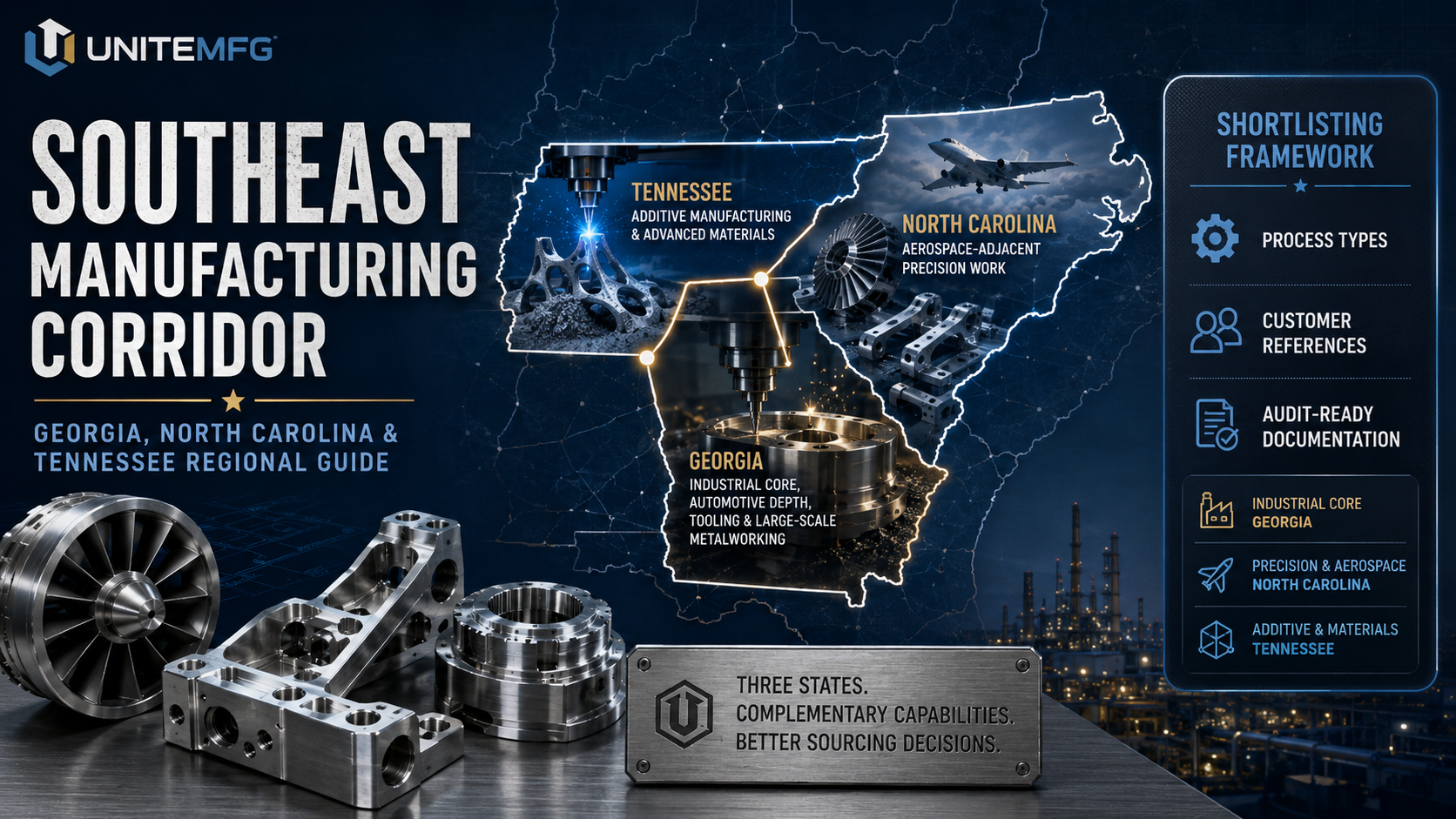
This guide helps procurement teams compare the three-state Southeast manufacturing corridor—Georgia, North Carolina, and Tennessee—when sourcing aerospace-adjacent components or precision parts domestically.
TL;DR
Here is how to evaluate the Southeast manufacturing corridor—Georgia, North Carolina, and Tennessee—as a unified sourcing option for aerospace-adjacent or precision components. This guide gives you the operational questions to ask before shortlisting any supplier in these three states.
The short version: The three-state corridor offers distinct but complementary capabilities. Georgia brings automotive depth and industrial tooling scale. North Carolina has growing aerospace-adjacent work, particularly around defense-adjacent testing and precision component work. Tennessee is emerging as an additive-manufacturing and advanced materials hub—but the gap between supplier marketing claims and verified capability remains significant across all three.
Why This Matters Now
Domestic reshoring momentum has accelerated sharply since 2020, driven by supply chain resilience concerns, defense/aerospace procurement pressure, and the simple reality that knowing your supplier matters more when you're buying domestically.
The problem is that most buyers treat these three states as separate searches instead of a unified corridor. That fragmentation wastes time, obscures capability patterns, and makes it harder to see where genuine supplier depth exists versus vendor-heavy marketing.
What actually works is framing this as one corridor with three complementary zones—and then asking the right questions about any specific supplier before committing a purchase order.
What the Evidence Shows
Public sources on Southeast manufacturing capabilities reveal distinct regional strengths:
Georgia: The Industrial Core
Georgia's manufacturing base centers heavily on automotive-adjacent work, industrial tooling, and metalworking at scale [1]. The state hosts a significant population of suppliers with deep experience in high-mix production environments—particularly around the I-75 corridor through the state's southern quadrant [3].
Where capability claims hold up: Suppliers with 10+ year track records in automotive or industrial tooling tend to have documented quality systems and inspection protocols that transfer well to aerospace-adjacent work. The risk profile is relatively predictable here because these suppliers have been operating under OEM scrutiny for years.
Where claims break down: "Aerospace grade" language appears in supplier marketing more often than verified AS9100D or ITAR compliance warrants. Several suppliers position themselves as aerospace-capable based on process overlap alone—not actual certification depth.
North Carolina: The Emerging Aerospace Corridor
North Carolina has been building out its aerospace-adjacent manufacturing base [4], with particular density around precision component work and defense-adjacent testing facilities. The state benefits from proximity to Southeast coast logistics without the full cost structure of Northeast coastal markets.
Where capability claims hold up: Newer supplier entries in North Carolina tend to have more modern quality documentation practices—many built their quality systems post-2020 with current compliance frameworks already integrated, not retrofitted onto older ISO-era setups.
Where claims break down: The aerospace-adjacent label covers a wide range. Some suppliers are genuinely operating at Tier 1/2 quality levels; others use the framing as marketing without having worked with prime customers who actually enforce that bar.
Tennessee: The Additive and Materials Frontier
Tennessee's manufacturing base has been developing particularly around additive manufacturing, advanced materials work [5], and emerging aerospace-adjacent processes. Several facilities have invested in powder-based capabilities that weren't commercially relevant five years ago [6].
Where capability claims hold up: Suppliers who have invested specifically in additive capabilities tend to have better-documented parameter capture and chain of custody practices—the hardest part of making printed parts audit-ready is often the documentation infrastructure, not the printing itself.
Where claims break down: The "advanced materials" label gets used very loosely. Some facilities have genuine multi-process capability (additive + conventional). Others are running hobbyist-grade equipment and calling it industrial-class additive.
Where the Corridor Decision Frame Fits
The practical question is not "which state is best?"—the answer is all three matter, differently. The practical question is: for any specific supplier in this corridor, what do I actually need to verify before committing a purchase order?
Three Questions That Actually Matter
Question 1: What process types are you running today?
This matters because process overlap ("we already machine, so printing is trivial") does not equal process capability. A supplier can run a laser and still have zero validated print parameters for your material class. Ask specifically what processes they use to fulfill orders in the last 90 days—not just "what do you offer."
Question 2: Who are three current or recent customers who would verify your quality claims?
A buyer should never accept supplier self-description as proof of capability. The right answer is a named customer with enough context that you can actually call them—company name, general order type, and approximate timing. Vague "NDA" answers or claimed-but-unnamed brand customers are a red flag.
Question 3: What documentation do you provide for audit-ready work?
For aerospace-adjacent components, the buyer often needs more than a packing slip and invoice. Chain of custody documentation, parameter capture records, material batch traceability—these have different meanings at different supplier tiers. Know what your compliance requirements actually demand before asking.
Risks / Red Flags
The "Aerospace Grade" Inflation Problem
Suppliers across all three states use "aerospace grade" language far more freely than actual AS9100D or ITAR-compliant work warrants [2]. This is not always dishonest—some suppliers genuinely intend to get there and are working through certification. But the gap between marketing positioning and verified compliance is massive in this corridor.
How to handle it: Ask for specific documentation rather than accepting category claims. Any supplier who has actually worked with Tier 1/2 customers will expect this question and have a clear answer about what their current compliance posture looks like.
Single-Process Lock
Suppliers positioned as "additive manufacturing specialists" are often running one process type on hobbyist-grade equipment without validated parameters for the material class you need. The additive category is broad (FDM, SLS, B) — each has different capability boundaries and your part may not be in their sweet spot even if they're technically an "additive supplier."
Capacity Disconnect
Several Southeast suppliers market capacity they do not actually have when asked to commit to specific lead times during high-demand periods. This disconnect between quoted availability and actual throughput is a known failure mode across all three states, particularly around year-end close periods.
Recommended Next Move
If you are evaluating any Georgia, North Carolina, or Tennessee supplier for aerospace-adjacent components:
1. Map your compliance requirement first. Know whether you need full AS9100D/ITAR compliance, defense-adjacent documentation, or industrial-grade quality before starting supplier conversations. The wrong expectation wastes everyone's time.
2. Ask the three questions above as a baseline shortlisting filter—any supplier who cannot provide named customer references and clear answers about process type is not ready for your purchase order yet.
3. Request a sample workflow if you have a part that would be representative of what you'd actually order—this tests documentation quality, communication cadence, and parameter capture in practice rather than accepting marketing claims at face value.
4. Start with the lowest-dollar commitment possible to validate actual behavior before scaling volume. A $500 test order reveals more than a $50,000 promise during vendor selection conversations.
References
- National Institute of Standards and Technology (Current as of access). Georgia MEP at Georgia Tech [Link]
- SAE International (2016-09-20). SAE AS9100D [Link]
- Georgia Department of Economic Development (Current as of access). Georgia Aerospace [Link]
- North Carolina Department of Commerce (Current as of access). North Carolina Aerospace & Defense [Link]
- Tennessee Department of Economic and Community Development (Current as of access). Tennessee Advanced Manufacturing [Link]
- U.S. Department of Energy (Current as of access). ORNL Manufacturing Demonstration Facility [Link]