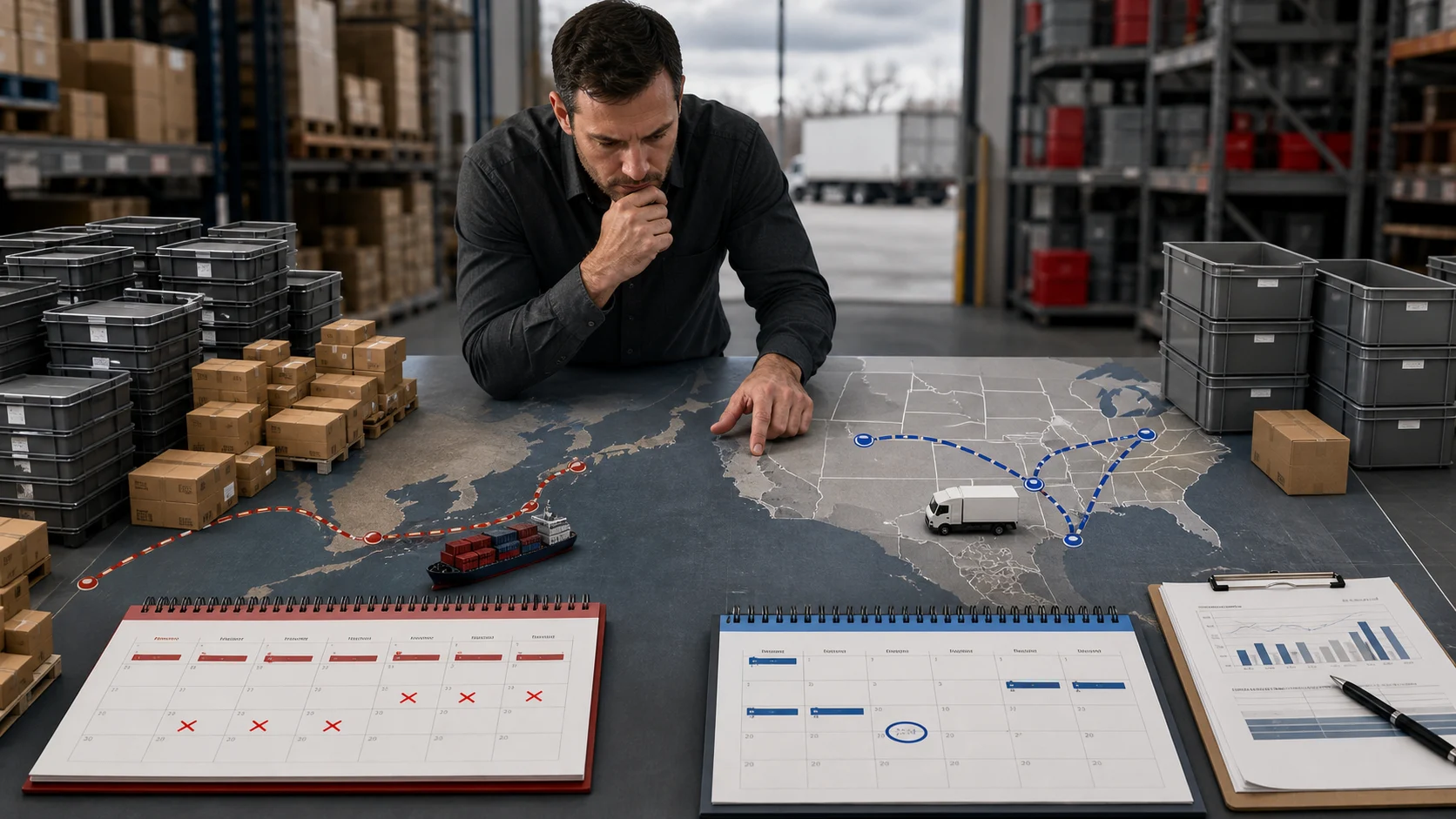
Unit price is one line in a sourcing decision. The operating route determines how much cash, schedule, quality, and recovery capacity the company actually buys.
TL;DR
Compare sources using a common demand and acceptance baseline. Model landed cost, tooling, freight, tariffs, inventory carrying cost, payment terms, quality and rework, engineering and supplier-management effort, forecast error, obsolescence, disruption, and recovery—not just quoted unit price.
Domestic is not automatically lower-risk, faster, or better. Verify the exact facility, raw- material sources, sub-tiers, capacity, lead-time definition, and recovery plan. The correct decision may be domestic, offshore, nearshore, or deliberately dual-sourced.
Unit Price Hides the Operating System
Two quotes can show the same drawing and quantity while pricing different realities:
- one includes tooling maintenance and another excludes it;
- one uses domestic raw material and another imports it;
- one ships weekly and another requires a container lot;
- one performs special processes internally and another adds two opaque sub-tiers;
- one includes inspection records and another treats them as extra;
- one commits to replenishment lead time and another quotes only manufacturing time.
Normalize the route before comparing the number.
Total-Cost Model
NIST MEP describes total cost of ownership as a broader view that includes freight, tariffs, longer lead times, higher inventory, distant-supplier management, lost-sales risk, and other internal and external considerations [1].
| Cost or risk | Question to quantify |
|---|---|
| Unit and tooling | What is recurring, one-time, maintained, replaced, or amortized? |
| Freight and handling | Which modes, lanes, consolidation, insurance, brokerage, and expedites? |
| Duties and fees | Which classification, origin, tariff, and compliance assumptions apply? |
| Pipeline inventory | How much demand is tied up during production and transit? |
| Safety stock | What variability and recovery time must inventory cover? |
| Quality | Incoming inspection, sorting, scrap, rework, returns, line disruption, and warranty? |
| Engineering | Time-zone delay, translation, travel, samples, changes, and qualification? |
| Working capital | Deposit, milestone, shipment, receipt, and acceptance payment terms? |
| Forecast error | Minimum order, batch, cancellation, obsolescence, and excess exposure? |
| Disruption | Probability, duration, affected margin, and mitigation cost? |
| Recovery | Alternate tool, source, material, approval, capacity, and time to restart? |
Keep ordinary expected costs separate from scenario risk. Otherwise a dramatic but unbounded “risk adder” can be used to justify any preferred answer.
Model Lead Time as a Timeline
Break lead time into:
- engineering review and clarification;
- material procurement;
- tooling or programming;
- production queue;
- manufacturing;
- outside processing;
- inspection and release;
- consolidation;
- transport;
- customs or border handling where applicable;
- receiving and incoming acceptance; and
- issue-resolution buffer.
Ask whether the quoted lead time begins at purchase order, technical approval, deposit, material receipt, or forecast release. Ask whether it ends at ship date or usable inventory.
The shorter nominal route is not necessarily the more reliable one. Track promised-to-actual performance and the distribution of lead time, not only an average.
Inventory Is a Schedule Insurance Policy
For each sourcing route calculate:
- average demand during replenishment;
- demand variability;
- supplier and transit variability;
- minimum order and production batch;
- pipeline inventory;
- cycle stock;
- required safety stock;
- carrying cost;
- expiration, corrosion, revision, or obsolescence exposure; and
- shortage consequence.
A lower unit price can require a larger order, longer cash cycle, and more revision exposure. A higher unit price can still be more expensive if the domestic supplier has unreliable material availability or no surge capacity. Use the actual route.
Price the Cost of Change
Manufactured products change. Compare:
- engineering-question turnaround;
- manufacturability-review quality;
- sample and first-article loop time;
- drawing and program revision control;
- tooling modification time;
- authorization threshold for deviations;
- minimum quantity stranded by a change;
- ability to visit or work in real time; and
- evidence that obsolete configuration is contained.
The value of proximity is often not distance itself. It is fewer hours between detecting a problem, reaching the right people, seeing the work, approving a response, and receiving usable replacement product.
Recovery Must Be Demonstrable
NIST MEP's supply-chain guidance recommends mapping risk and considering secondary or alternative suppliers and safety stock [1]. Test every proposed recovery:
| Recovery claim | Evidence to request |
|---|---|
| “We have another plant” | Exact facility, equipment, approvals, data transfer, and qualification time |
| “We can add a shift” | Labor, supervision, maintenance, tooling, and material constraints |
| “Tooling is transferable” | Ownership, location, condition, interface, drawings, and trial plan |
| “Material is readily available” | Approved mills/distributors, allocation, mill minimum, and normal history |
| “We can expedite” | Realistic queue bypass, premium, transport, and prior performance |
| “We have backup processors” | Approved scope, lead time, qualification, and capacity |
A second distributor for the same constrained mill source is not source diversification.
Compare Three Scenarios
Build a base case and at least two stress cases:
Base case
Expected demand, normal quality, normal freight, and quoted replenishment.
Demand or engineering shock
A surge, product revision, tooling repair, or unexpected service requirement. Measure time and cash to respond.
Supply interruption
Material shortage, processor outage, port or lane disruption, quality containment, or supplier capacity loss. Measure days to controlled recovery and contribution margin at risk.
Use consistent probabilities only where there is evidence. Scenario results can be more honest than a single “risk-adjusted unit cost.”
Domestic-Supplier Qualification
NIST MEP operates Supplier Scouting to identify domestic manufacturers by needed capability [2]. Whether using that network, UNITEMFG, or direct research, verify:
- exact U.S. manufacturing location;
- U.S. and imported content by critical input;
- processes performed internally;
- controlled sub-tiers;
- material availability;
- practical capacity and order fit;
- quality and record capability;
- tooling ownership and portability;
- normal and expedited logistics; and
- performance on comparable work.
“Made in USA” claims involve separate legal requirements and should not be inferred from a U.S. sales office or final assembly location. Obtain appropriate legal review for labeling decisions.
Sourcing Decision Sheet
- Requirements and annual demand are identical across quotes.
- Currency, Incoterms, freight, duties, and insurance are normalized.
- Tooling, maintenance, ownership, and transfer are priced.
- Lead time runs from released order to accepted inventory.
- Pipeline, cycle, and safety inventory are valued.
- Quality, engineering, and supplier-management work are included.
- Change and forecast-error exposure are modeled.
- Sub-tier and raw-material concentration are visible.
- Recovery claims have named resources and time.
- Base, shock, and interruption scenarios are compared.
A Better Decision
Domestic sourcing wins when its complete operating route produces the best combination of cost, responsiveness, control, and recovery for the product. Offshore or nearshore sourcing can still be correct where capability, scale, economics, and risk controls support it. Make the decision at the part-family and route level—not as an ideological companywide rule. Use Intelligent Sourcing when the domestic route or capability set still needs to be resolved.
Related Articles
References
- National Institute of Standards and Technology Manufacturing Extension Partnership, Supply Chain Management.
- National Institute of Standards and Technology Manufacturing Extension Partnership, Supplier Scouting.