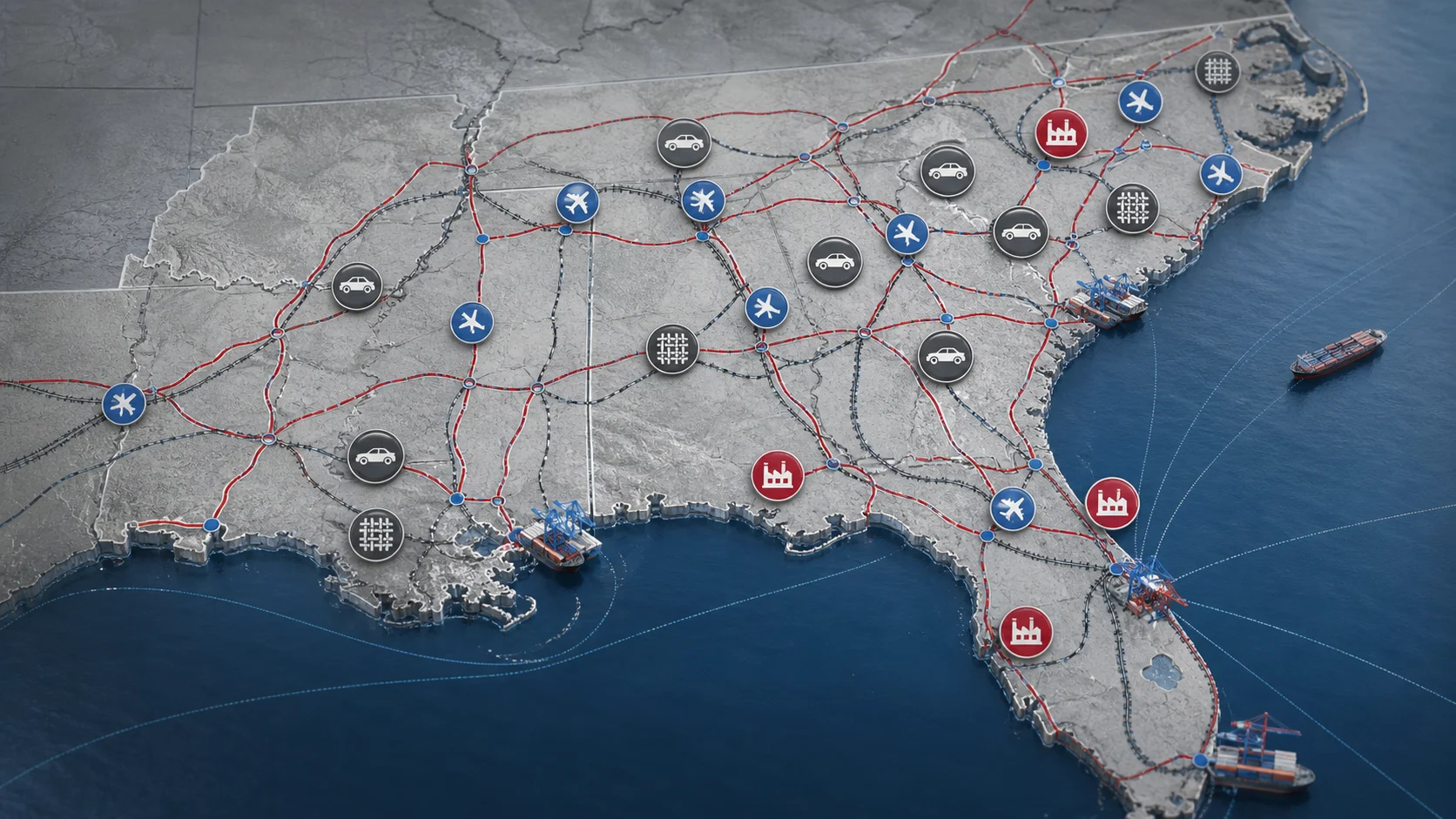
The Southeast is not one supplier market. Treat it as a connected set of manufacturing systems and verify capability at the establishment level.
TL;DR
Use the Southeast as a research boundary, not as a supplier qualification. Start with the process, material, scale, tolerance, quality, and delivery requirements. Then search connected state and metro markets, validate actual establishments, and model freight and sub-tier routes.
Public data can show where an industry has establishments and employment, but a regional total cannot prove that a particular plant has the machine, certification, capacity, or willingness to quote your work. Build the shortlist at facility level.
What “Southeast Manufacturing Corridor” Means Here
There is no single procurement-standard boundary for the Southeast. For sourcing work, a practical first pass can include Alabama, Florida, Georgia, Kentucky, Mississippi, North Carolina, South Carolina, Tennessee, and Virginia, then expand or contract by freight lane and supplier fit.
The useful idea is connectivity: dense interstate routes, ports, airports, universities, manufacturing extension organizations, OEM plants, contract manufacturers, toolmakers, processors, and logistics providers form overlapping systems. The region contains activity in aerospace, automotive, textiles, fabricated metals, plastics, electronics, and industrial equipment, but those labels are only starting points.
Search Capability, Not a Regional Slogan
Translate the need into a capability statement:
| Requirement layer | Example questions |
|---|---|
| Process | Stamping, molding, machining, fabrication, casting, assembly, test, or finishing? |
| Material | Which alloy, polymer, textile system, composite, or purchased component? |
| Geometry | Envelope, thickness, draw depth, bend, cavity, feature access, and tolerance? |
| Scale | Prototype, bridge, low-rate, or repetitive production? |
| Quality | Which management system, special-process approval, inspection, and records? |
| Supply chain | Which outside processes, tooling, raw stock, and constrained components? |
| Delivery | Required lane, batch, packaging, service part, and recovery expectations? |
A company serving “aerospace” may make only ground-support equipment. An automotive supplier may be optimized for high-volume production and reject a low-volume industrial job. An established textile producer may have material and finishing strengths that do not extend to your regulated application. Industry experience matters only when its specific capabilities transfer.
Build an Evidence-Based Regional Map
County Business Patterns publishes establishment, employment, and payroll data by geography and NAICS industry [1]. Use it to answer:
- Which states or metros show meaningful establishment activity in the target NAICS?
- Is the apparent cluster made of many small establishments or a few large ones?
- Which neighboring counties should be searched together?
- Does the target process sit under a different NAICS than the end market?
CBP describes an establishment as a physical business location and notes that it is not necessarily the same as a company [2]. That distinction matters: the corporation may advertise a capability that exists at a different plant.
BLS state and metro employment data provide a more current labor-market lens [3]. Employment is not capacity, but it can help test whether a claimed manufacturing concentration has an operating workforce behind it.
Four Useful Search Lenses
Aerospace and defense work
Search beyond primes and airframe labels. Relevant sub-tiers may include:
- precision machining and fabrication;
- composites and bonded structures;
- harnesses and electronics;
- tooling and ground-support equipment;
- special processing and NDT;
- test equipment;
- packaging and controlled logistics.
Define export-control, customer approval, cybersecurity, material, inspection, and record requirements before outreach. Do not use an aerospace certificate as a substitute for process scope and customer approval.
Automotive and mobility
Separate:
- production components;
- tooling, dies, fixtures, gauges, and automation;
- prototype and launch support;
- service parts;
- heavy vehicle and off-highway equipment; and
- electrification subsystems.
The correct supplier for repeat production may not be the correct supplier for tooling or engineering changes. Ask about program volume, release mechanism, EDI or portal requirements, packaging, PPAP expectations, run-at-rate, and service obligations.
Textiles and engineered materials
Do not reduce the textile search to cut-and-sew. Capabilities can include yarn, weaving, knitting, nonwovens, coating, lamination, dyeing, finishing, converting, reinforcement, filtration, and protective products.
Specify fiber and material system, construction, finish, performance tests, restricted substances, lot control, color tolerance, width, yield, and minimum production quantity. A supplier's end-market language may hide a transferable process.
Industrial equipment
Equipment supply chains commonly combine:
- plate and structural fabrication;
- machining;
- cast or forged components;
- hydraulic and pneumatic systems;
- electrical panels and controls;
- paint and coating;
- assembly, test, and field support.
Evaluate the complete route. A capable assembler with weak control of outside processes can create more schedule risk than a smaller integrator with a visible sub-tier network.
Freight Is Part of Capability
FHWA's National Highway Freight Network identifies highway portions important to freight movement, including the Primary Highway Freight System and other Interstate and critical corridors [4]. For sourcing, map:
- supplier to your receiving point;
- raw-material source to supplier;
- supplier to heat treat, plating, testing, or other sub-tier;
- port or airport exposure where applicable;
- normal and expedited route;
- border crossings for any non-U.S. content; and
- weather or single-corridor concentration.
Distance alone is a weak proxy. A supplier 500 miles away on a reliable direct lane may be more responsive than one 120 miles away with weekly consolidated service and several opaque sub-tier moves.
Facility-Level Qualification
For every candidate, verify:
- legal name and exact manufacturing address;
- processes performed at that address;
- equipment envelope and practical tolerance range;
- materials and product types routinely handled;
- current certification and approval scope;
- prototype and production volume fit;
- internal versus outsourced operations;
- tooling, programming, and inspection ownership;
- current capacity and quoted lead time;
- contingency and alternate-source plan; and
- willingness to support the required commercial model.
Use the UNITEMFG U.S. manufacturing directory to create the initial candidate set, then confirm each claim directly with the facility.
A Better Regional Shortlist
Score evidence, not marketing:
| Dimension | Strong evidence |
|---|---|
| Process fit | Similar equipment, material, geometry, and demonstrated work |
| Scale fit | Current programs with comparable batch and annual volume |
| Quality fit | Applicable scope, controlled inspection, and sample records |
| Supply-chain fit | Named and controlled sub-tiers with realistic transit |
| Launch fit | Clear ownership for review, tooling, first article, and changes |
| Recovery fit | Alternate route, escalation path, and credible capacity response |
| Commercial fit | Transparent assumptions, tooling, minimums, and price breaks |
Geographic proximity can improve collaboration and recovery. It does not compensate for missing capability.
Research Workflow
- Define the part, process, evidence, volume, and delivery need.
- Select relevant NAICS codes and adjacent process categories.
- Compare state, metro, and county establishment patterns.
- Search UNITEMFG profiles and state manufacturing resources.
- Group candidates by actual plant, not corporate brand.
- Map raw material and outside-process dependencies.
- Send a controlled capability screen before the full RFQ.
- Normalize quotes and visit or audit finalists according to risk.
- Preserve verified facility facts for future sourcing.
The Regional Advantage Is a Network Advantage
The best reason to source in the Southeast is not a generic claim about costs or business climate. It is the ability to assemble a qualified, connected route for the specific work: manufacturer, toolmaker, processor, laboratory, logistics path, and recovery option. Build that route with data, then verify it with people and records.
Related Articles
- Build a U.S. Manufacturer Shortlist by Capability
- Domestic Sourcing Beyond Unit Price
- Supplier Quality Audit
References
- U.S. Census Bureau, County Business Patterns.
- U.S. Census Bureau, County Business Patterns Methodology.
- U.S. Bureau of Labor Statistics, State Employment and Unemployment.
- Federal Highway Administration, National Highway Freight Network.