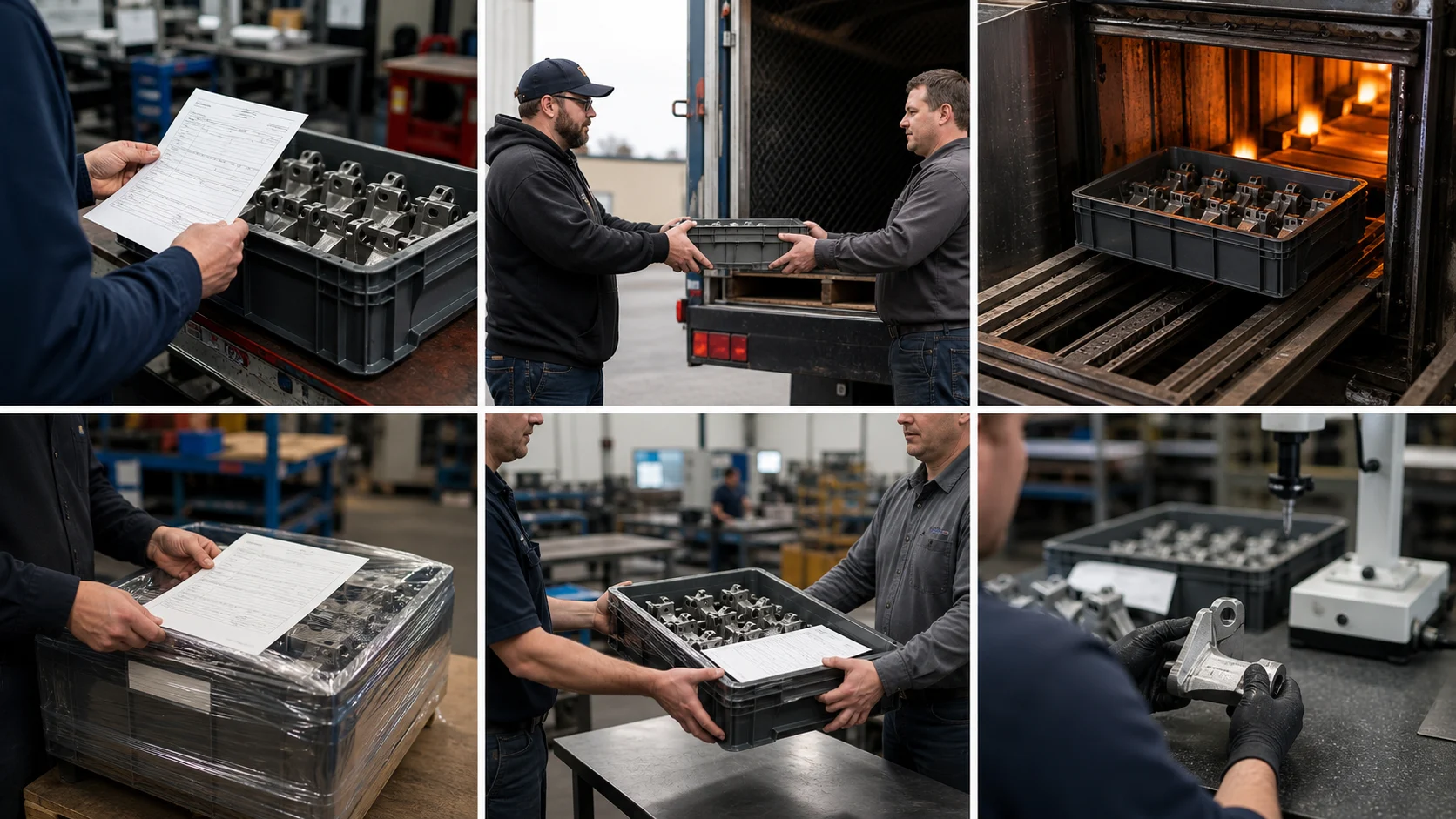
“At the vendor” is not a production status. Outside-process control must preserve lot identity, requirements, quantity, location, due date, evidence, and acceptance.
TL;DR
An outside-process record should answer: what items left, which lot they belong to, where they went, under which purchase requirements, which operations and revisions apply, when they are due, what evidence must return, what quantity and condition came back, and who accepted the result.
Control the complete loop: release, pack, ship, acknowledge, process, communicate, return, receive, review certificates, inspect, reconcile quantity, handle nonconformance, and release to the next operation. The originating manufacturer remains responsible for controlling the requirement even when another organization performs the work.
Outside Processing Extends the Production System
Heat treatment, plating, anodizing, coating, welding, NDT, laboratory testing, grinding, cleaning, and other specialist operations are often performed by sub-tier suppliers. The work leaves the building, but product responsibility does not.
FAA guidance for production approval holders requires supplier control based on criticality and complexity and includes special processes among product-risk considerations [1]. Outside aviation, the contractual framework changes, but the operational principle remains: control depth should follow product and process risk.
Minimum Outside-Process Record
| Field | Purpose |
|---|---|
| Internal job, part, revision, and operation | Connects the service to the authorized route |
| Material heat, lot, batch, or serial identity | Preserves genealogy |
| Quantity sent | Establishes custody |
| Supplier and approved process scope | Confirms the intended source |
| Purchase order and line | Controls commercial and technical flowdown |
| Process specification and revision | Defines the operation |
| Special instructions | Captures masking, fixturing, hardness, thickness, test, or handling |
| Ship date and acknowledged receipt | Establishes location and custody |
| Required and committed return dates | Supports schedule control |
| Certificate and test deliverables | Defines closure evidence |
| Quantity and condition returned | Reconciles parts |
| Review and acceptance | Releases the lot to its next operation |
Release: Send a Controlled Lot
Before shipment:
- confirm part and revision;
- verify operation sequence;
- reconcile quantity;
- preserve heat, lot, batch, and serial identity;
- protect critical surfaces;
- identify customer property;
- issue the correct purchase order and requirements;
- attach controlled processing instructions where needed;
- establish due date and escalation contact;
- record carrier and shipment identity.
Do not mix lots for convenience unless the requirement and traceability plan allow it.
Flow Down the Result, Not Just the Process Name
“Heat treat per print” or “black anodize” may omit:
- governing specification and revision;
- alloy and incoming condition;
- final condition, hardness, or case depth;
- processing class or type;
- thickness and significant surfaces;
- masking and plugging;
- approved source or accreditation;
- sampling and test methods;
- certificate content;
- rework restrictions;
- notification and deviation authority.
The processor should not need to infer requirements from a cropped drawing screenshot.
Status: Replace “At Vendor”
Useful status states include:
- ready to send;
- shipped;
- received and acknowledged;
- queued;
- processing;
- inspection or test;
- certificate pending;
- ready to return;
- in transit;
- received pending review;
- accepted;
- blocked or nonconforming.
Every blocked state needs a reason, owner, next action, and decision date. A promised date without the processor's acknowledged capacity is not a reliable production date.
Return: Physical Parts and Evidence Arrive Together
At receiving:
- reconcile quantity;
- inspect shipping damage and preservation;
- verify part and lot identity;
- confirm that unauthorized commingling did not occur;
- collect certificates and raw results where required;
- verify supplier, process, specification, revision, and dates;
- compare reported results with acceptance criteria;
- record scrap, test coupons, or retained samples;
- place the lot on hold until review is complete.
NASA's quality handbook example requires processing certifications demonstrating that required forming, heat treating, thermal cycling, conversion, and other processes occurred and met requirements [2]. A certificate is part of acceptance evidence; it does not replace review.
Certificate Review Matrix
| Certificate element | Review question |
|---|---|
| Processor identity and address | Is this the approved facility and scope? |
| Customer purchase order | Does it match the released service? |
| Part and revision | Was the correct configuration processed? |
| Lot or serial identity | Can the evidence be tied to the returned items? |
| Specification and revision | Was the correct requirement applied? |
| Process result | Are actual values present when required? |
| Quantity | Does it reconcile with sent, returned, tested, and scrapped? |
| Signature or approval | Is the certification authorized? |
| Deviations and rework | Were changes approved and fully disclosed? |
JPL's current NDT certificate clause, for example, calls for the purchase order, processor, inspection date, quantity, acceptance criteria, personnel qualification level, specification revision, item traceability, result, and rework references [3]. Use the actual contract for the job; the clause demonstrates how much more specific “NDT cert required” can become.
Accreditation Does Not Eliminate Job Control
PRI's Nadcap program applies industry-managed audit criteria to critical processes including heat treating, NDT, welding, and chemical processing [4]. When Nadcap or another approval is required, verify:
- exact facility;
- commodity and process scope;
- specification coverage;
- expiration and status;
- customer approval where separate;
- use of sub-tiers;
- whether the specific operation falls within the accredited scope.
Accreditation can reduce duplicated system auditing. It does not prove that your purchase order, lot, revision, or acceptance evidence was correct.
Recovery Planning
For critical outside processes, record:
- alternate approved source;
- transfer and requalification requirements;
- typical queue and expedited path;
- transport time;
- batch minimum and maximum;
- rework or strip-and-reprocess limits;
- test-coupon needs;
- tooling, rack, fixture, or mask ownership;
- processor shutdown and holiday exposure.
The best time to qualify a backup is before a late lot is physically trapped at the primary processor.
Outside-Process Audit Test
Select one returned lot and trace:
- internal operation to purchase order;
- quantity and identity sent;
- processor receipt;
- process batch or load;
- test and certificate;
- quantity and identity returned;
- certificate review;
- internal acceptance and next operation.
Then select one open purchase order and prove current physical location, state, committed date, and blocker.
A Restrained Next Move
Replace the free-text “outside” operation with a controlled status and acceptance record. The workflow belongs with the manufacturing job, material identity, supplier, purchase order, and quality history—the kind of cross-functional operating record the AIURION manufacturing operations platform is intended to maintain.
Related Articles
- Material Traceability
- Quote-to-Production Handoffs
- Quality History as a Reusable Manufacturing Asset
References
- Federal Aviation Administration, AC 21-43 — Production Under 14 CFR Part 21. Used for the risk-based supplier-control principle.
- National Aeronautics and Space Administration, NASA-HDBK-6025.
- NASA Jet Propulsion Laboratory, QC14b — Nondestructive Inspection and Test Certificate.
- Performance Review Institute, Nadcap.