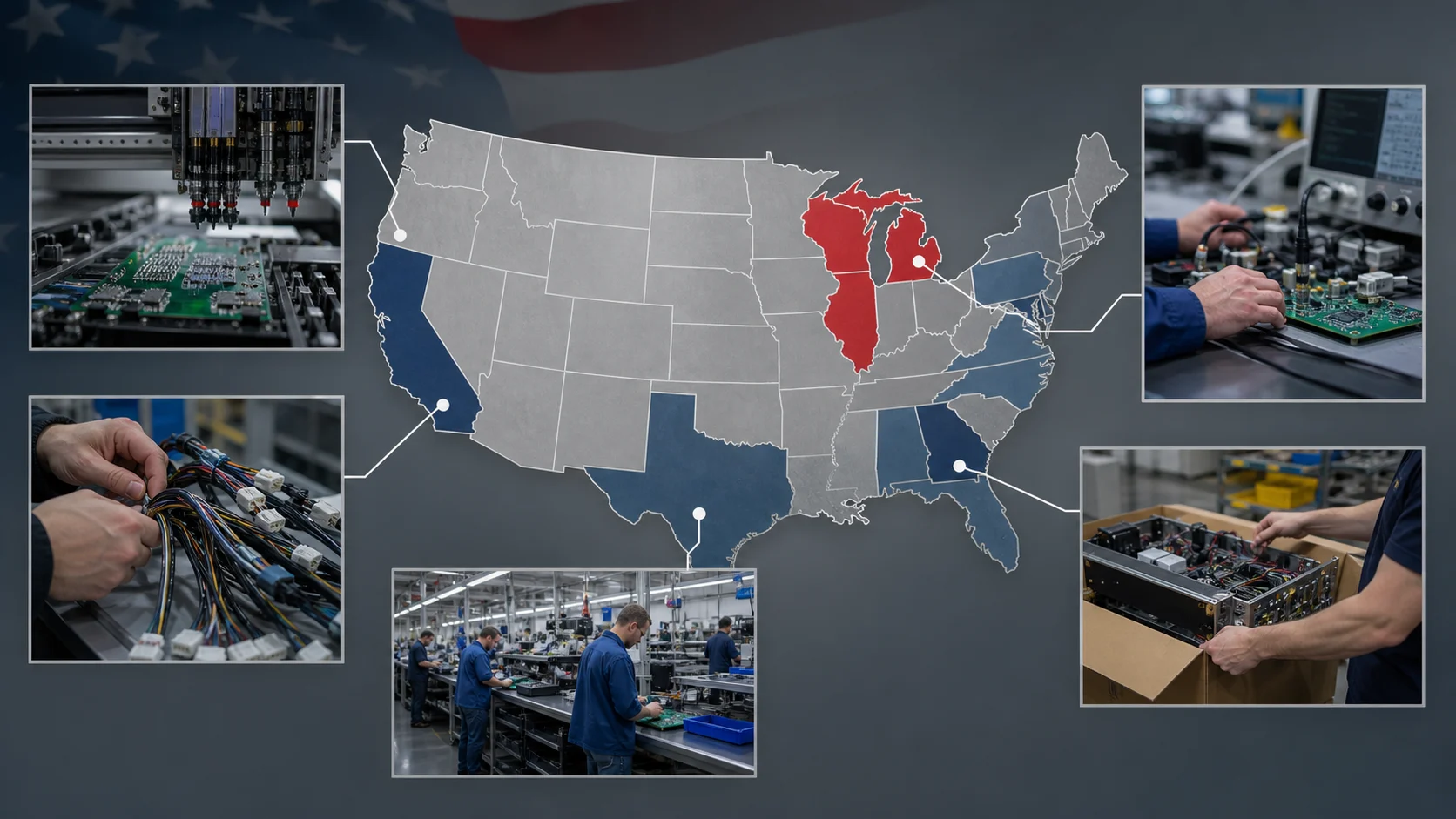
“EMS” can mean prototype PCB assembly, complex box build, cable and harness work, testing, fulfillment, or an entire product lifecycle. Define the service boundary before comparing suppliers.
TL;DR
U.S. electronics manufacturing services providers vary widely. Some specialize in rapid prototype printed-circuit assemblies; others manage component sourcing, SMT and through-hole assembly, cable and harness, box build, programming, functional test, environmental screening, repair, configuration, and fulfillment.
Select by product class, technology, component risk, test responsibility, traceability, regulatory or contractual controls, engineering support, launch model, and realistic production volume. Geography helps when engineering interaction, IP sensitivity, replenishment speed, or recovery matters—but capability and supply-chain control still decide the award.
“Electronics Manufacturing” Is Not One Capability
The Census Bureau defines NAICS 334418 as establishments primarily engaged in loading components onto printed circuit boards or manufacturing and shipping loaded printed circuit boards [1]. That is narrower than the full commercial use of “EMS,” which may include:
- design-for-manufacture and design-for-test review;
- bare-board sourcing;
- component procurement and lifecycle management;
- SMT, through-hole, selective solder, and hand assembly;
- cleaning and conformal coating;
- cable and wire-harness assembly;
- mechanical integration and box build;
- firmware loading and serialization;
- in-circuit, boundary-scan, flying-probe, and functional test;
- environmental or reliability screening;
- repair, depot, fulfillment, and end-of-life support.
Map which responsibilities remain with the product company and which transfer to the EMS provider.
Regional Research Without Mythology
Electronics capabilities exist across the country, often near:
- aerospace and defense programs;
- medical-device clusters;
- semiconductor and advanced-packaging ecosystems;
- telecommunications and computing centers;
- automotive and industrial-controls manufacturing;
- research universities and federal laboratories.
Use County Business Patterns and NAICS data to identify establishment density, then verify the actual site. Do not infer surface-mount capability, security controls, clean assembly, or available capacity from regional reputation.
Domestic location can improve engineering access and replenishment time. It does not make the component supply chain domestic. Commerce's ICT supply-chain assessment identifies risks such as limited domestic capacity and dependence on single-source or single-region suppliers [2]. Ask where boards, semiconductors, passives, connectors, displays, batteries, and enclosures originate.
EMS Capability Matrix
| Product need | Supplier evidence | Hidden boundary |
|---|---|---|
| Fine-pitch SMT and bottom-termination devices | Equipment, process controls, inspection, rework competence, sample technology | Placement capability does not establish solder-joint reliability |
| High-mix prototypes | Fast programming, material substitution control, engineering access | Prototype process may not scale to production |
| Regulated or high-reliability product | Applicable QMS scope, trained personnel, validation and traceability | Employee certification is not facility qualification |
| Cable and harness | Crimp tooling, pull-test controls, workmanship standard, continuity test | PCB competence does not imply harness competence |
| Box build | Mechanical sourcing, torque, adhesives, configuration, functional test | “Assembly” may stop at the circuit board |
| Functional test | Test-equipment ownership, software control, fault coverage, data retention | Customer may still own fixtures and test code |
| Lifecycle support | Obsolescence process, last-time buys, alternates, redesign boundary | Procurement services may not include engineering authority |
Standards: Name the Revision and Contract
IPC develops standards across the electronics product-development cycle [3]. Common references may include:
- IPC-A-610 for electronic-assembly acceptance;
- J-STD-001 for soldered electrical and electronic assemblies;
- IPC/WHMA-A-620 for cable and wire-harness requirements and acceptance;
- IPC-7711/7721 for rework and repair;
- IPC-1782 for manufacturing and supply-chain traceability.
Do not write “IPC certified” as a complete product requirement. Identify the applicable document, revision, class, amendments, customer additions, workmanship exceptions, and order of precedence. IPC distinguishes personnel certification from validation programs used to verify manufacturing processes against standards [4].
Component and Material Control
Ask how the supplier manages:
- approved manufacturer list and bills of material;
- customer-approved alternates;
- authorized distribution;
- counterfeit avoidance and traceability;
- moisture-sensitive devices;
- date-code and lot restrictions;
- shelf life and storage;
- electrostatic discharge;
- lead-free and restricted-substance requirements;
- component obsolescence;
- customer-supplied inventory;
- excess and attrition ownership.
IPC-1782 establishes risk-based traceability requirements for materials and processes across printed-board and mechanical assembly, with levels agreed between user and supplier [5]. Define the required level; “full traceability” is not self-executing.
Test Responsibility Must Be Explicit
Separate:
- manufacturing-process inspection;
- electrical continuity or structural test;
- programmed functional test;
- product verification;
- design validation;
- regulatory or safety certification.
The EMS provider may execute a customer-designed test without owning its coverage. Clarify who:
- defines requirements;
- designs and owns fixtures;
- develops and controls software;
- establishes limits;
- manages calibration;
- disposes failures;
- approves changes;
- retains raw results.
Quote Package
Include:
- controlled Gerbers, ODB++, IPC-2581, drawings, models, and fabrication notes as applicable;
- approved bill of materials with alternates policy;
- AVL and component-source restrictions;
- expected annual demand, releases, and product life;
- first-build and production quantities;
- workmanship and acceptance standards;
- traceability and serialization;
- programming and test requirements;
- customer-supplied fixtures, code, or material;
- cleaning, coating, labeling, packaging, and shipping;
- regulatory, security, export, and customer flowdowns;
- change-notification and approval rules.
Buyer Questions
- Which technologies are routine at this specific site?
- What work is performed internally and what is subcontracted?
- How are DFM findings documented and approved?
- How are component substitutions and shortage decisions controlled?
- What traceability can be demonstrated from shipped serial to component lot?
- Which inspection and test methods address the product's dominant failure modes?
- Who owns test fixtures, software, limits, and maintenance?
- What is the constraint at prototype, launch, and production volume?
- How are rework and repair authorized and recorded?
- What data package supports transfer to another facility?
A Restrained Next Move
Separate board assembly, cable, box build, test, and lifecycle services in the capability profile. Then use the U.S. Manufacturing Directory to identify EMS candidates by the work they actually perform, not the breadth of the acronym.
Related Articles
- How to Build a U.S. Manufacturer Shortlist by Capability
- Material Traceability
- Supplier Quality Audit
References
- U.S. Census Bureau, NAICS 334418 — Printed Circuit Assembly Manufacturing.
- U.S. Department of Commerce, ICT Supply Chain Assessment Fact Sheet.
- IPC International, IPC Standards for Electronics Manufacturing.
- IPC International, IPC Validation Services.
- IPC International, IPC-1782 — Standard for Manufacturing and Supply Chain Traceability.