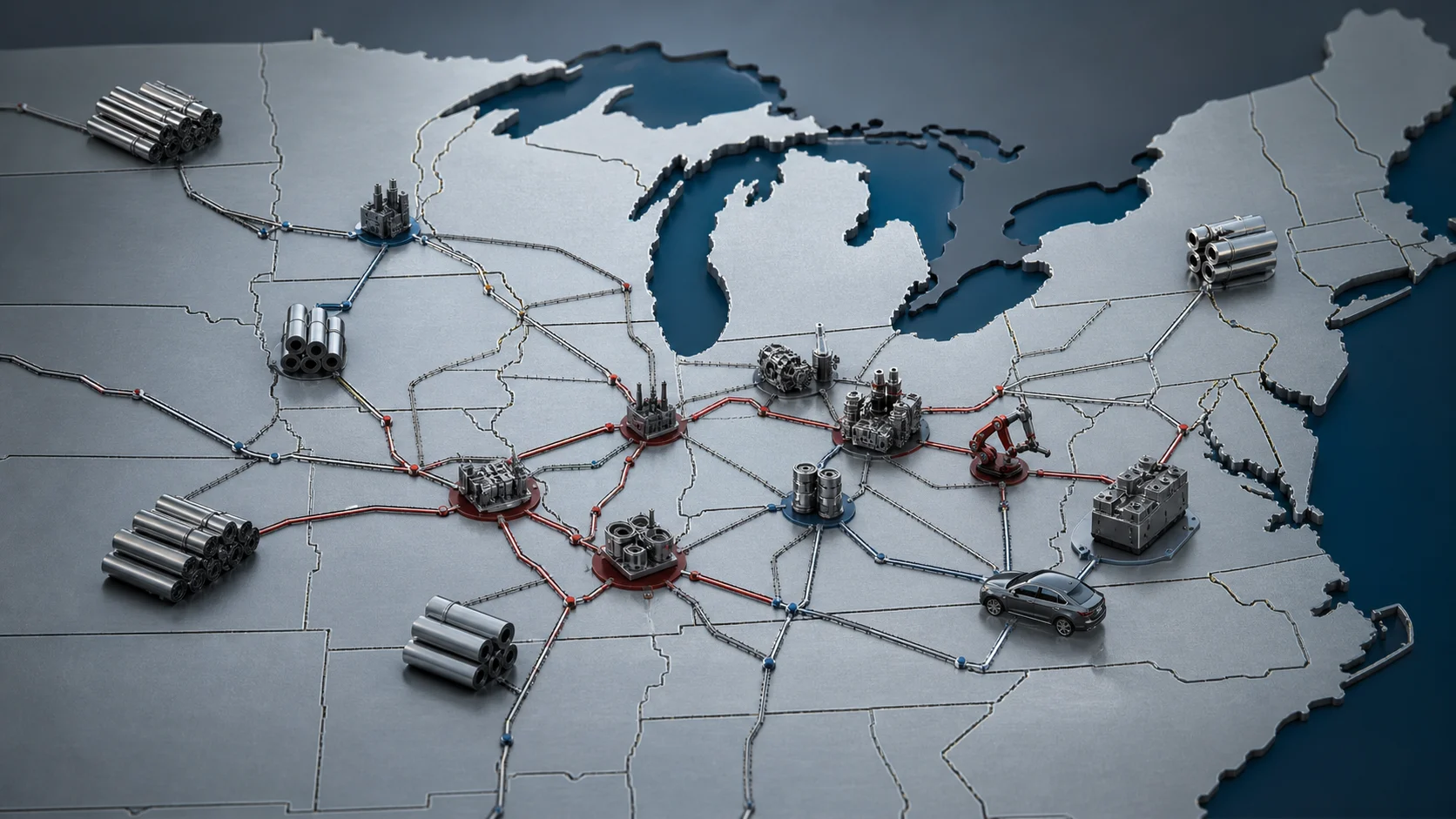
The Great Lakes corridor is not one uniform supplier market. Its value comes from overlapping metals, machinery, mobility, tooling, process, and freight ecosystems.
TL;DR
Treat the Great Lakes as a connected manufacturing system rather than a state-ranking exercise. Illinois, Indiana, Michigan, Ohio, Wisconsin, Pennsylvania, and western New York contain overlapping concentrations of primary metals, fabricated metal products, machinery, transportation equipment, plastics, electrical equipment, and specialist industrial services.
That density can shorten the distance between material suppliers, tool builders, production plants, heat treaters, coaters, inspectors, and repair resources. It does not mean every supplier in the region fits every part. Use establishment-level capability, certificate scope, logistics, and program fit to build the shortlist.
Define the Corridor by the Work
There is no single official sourcing boundary called the Great Lakes manufacturing corridor. For this guide, the useful footprint follows the U.S. industrial network around the lakes and its east-west connections: major portions of Illinois, Indiana, Michigan, Ohio, Wisconsin, Pennsylvania, and New York.
The Census Bureau's County Business Patterns program provides annual establishment, employment, and payroll data by detailed NAICS industry and geography [1]. That is the right kind of source for testing whether a claimed cluster exists. It is not a company-capability directory, and suppressed or noisy cells should not be reverse-engineered into false precision.
Current BLS state employment tables separately show manufacturing payroll employment by state [2]. Employment and establishment counts are useful measures of industrial depth; neither proves that an individual facility has open capacity.
Four Interlocking Capability Systems
Metals and material conversion
The corridor contains long-standing steel, aluminum, foundry, forging, rolling, service-center, heat-treatment, and finishing infrastructure. For buyers, the strategic benefit is not merely “metal is nearby.” It is access to:
- multiple product forms and conversion routes;
- mills, distributors, service centers, and processors;
- metallurgical and testing support;
- foundry, forging, stamping, fabrication, and machining capacity;
- secondary heat treatment and surface processing.
Material availability still depends on specification, melt source, minimum order, allocation, lead time, and traceability. Regional density does not make every alloy or section a stock item.
Machinery and industrial equipment
Machinery manufacturing spans purpose-built equipment, motion systems, pumps, conveyors, industrial furnaces, agricultural machinery, packaging systems, fluid power, and production tooling. Census NAICS definitions distinguish these industries and are useful for regional research [3].
Equipment supply chains often need more than part production:
- weldments and stress relief;
- large machining and grinding;
- gears, shafts, bearings, and motion components;
- electrical panels and controls;
- hydraulic and pneumatic integration;
- assembly, run-off, field service, and spare parts.
The supplier that can fabricate a base may not be able to machine it after welding or validate the assembled system. Map the complete route.
Mobility and transportation equipment
Michigan and the surrounding states anchor a dense automotive and mobility network, but the capability spillover is broader than vehicle assembly. Tool-and-die, metal stamping, plastic molding, casting, automation, gaging, joining, coatings, electronics, testing, and logistics all serve other industries.
Automotive experience can bring strong production and launch discipline. It can also bring business-model assumptions—large annual volume, dedicated tooling, customer-specific quality systems, and forecasted releases—that do not fit low-volume industrial work. Qualify the program, not just the pedigree.
Tooling and production support
A mature production region needs the companies that make and maintain production possible:
- stamping dies and mold tools;
- jigs, fixtures, gages, and checking fixtures;
- cutting tools and workholding;
- automation and system integration;
- machine rebuilding and repair;
- calibration, laboratory, and NDT services;
- coating, plating, heat treatment, and other outside processes.
This layer is often the real reason to source within a cluster. A production supplier with nearby tool repair, process support, and backup capacity may recover from disruption faster than a nominally cheaper isolated facility.
Freight Is Part of Capability
The corridor connects Great Lakes ports, rail systems, interstate highways, airports, and major border crossings. FHWA describes the Chicago–New York corridor through Illinois, Indiana, Michigan, Ohio, Pennsylvania, New Jersey, and New York as a major link between East Coast markets and the industrial and agricultural Midwest, with the Great Lakes among its waterway systems [4].
Do not translate transportation density into a generic “short lead time” claim. Freight fit depends on:
- shipment size and weight;
- border or customs exposure;
- hazardous or controlled material;
- packaging and corrosion prevention;
- expedited alternatives;
- port, rail, truck, or air interchange;
- supplier distance from the actual lane;
- weather and single-node disruption.
Capability-to-Region Research Matrix
| Requirement | Regional signal to research | Establishment-level proof still needed |
|---|---|---|
| Progressive stamping | Tool-and-die, coil processing, press and automotive supply-chain density | Press characteristics, material width, die scope, volume, inspection |
| Large weldment and machining | Machinery, heavy equipment, fabrication, stress relief | Crane capacity, envelope, datum strategy, post-weld sequence |
| Cast or forged component | Foundry or forging cluster plus heat treatment and machining | Alloy, part class, tooling, NDT, conversion, minimum lot |
| Injection-molded assembly | Molding, mold building, automation, assembly | Press tonnage, resin controls, tool ownership, validation, capacity |
| Production tooling | Tool-and-die ecosystem and repair services | Tool class, design ownership, tryout equipment, maintenance response |
| Outside processing | Heat treat, plating, coating, grinding, inspection | Approved scope, lot control, capacity, turnaround, evidence |
How to Build a Regional Shortlist
- Define the process and evidence profile.
- Search the U.S. Manufacturing Directory by capability and state.
- Use Census and BLS data to understand cluster depth, not to select a company.
- Verify the physical facility, not only corporate headquarters.
- Map critical outside processes and material sources around each candidate.
- Compare inbound, inter-process, and outbound logistics.
- Ask how the supplier responds when tooling, material, or capacity fails.
- Preserve at least one geographically distinct alternative for critical work.
What Not to Infer
- A regional cluster does not mean open capacity.
- An automotive supplier is not automatically qualified for aerospace or medical work.
- A corporate office in the region does not establish local production.
- A certification logo does not reveal its scope or covered address.
- A nearby supplier is not automatically lower risk if it depends on one distant processor.
- Establishment counts do not reveal willingness to quote custom work.
A Restrained Next Move
Search by process and state, then validate the exact facility and its supporting outside-process network. Start with the Ohio manufacturer directory, Michigan manufacturer directory, and Illinois manufacturer directory, but let capability—not state pride— determine the final shortlist.
Related Articles
- How to Build a U.S. Manufacturer Shortlist by Capability
- Domestic Sourcing Beyond Unit Price
- Outside-Process Tracking
References
- U.S. Census Bureau, County Business Patterns.
- U.S. Bureau of Labor Statistics, Employees on Nonfarm Payrolls by State and Selected Industry Sector.
- U.S. Census Bureau, North American Industry Classification System — Manufacturing.
- Federal Highway Administration, Chicago–New York City Corridor Freight Transportation Infrastructure.