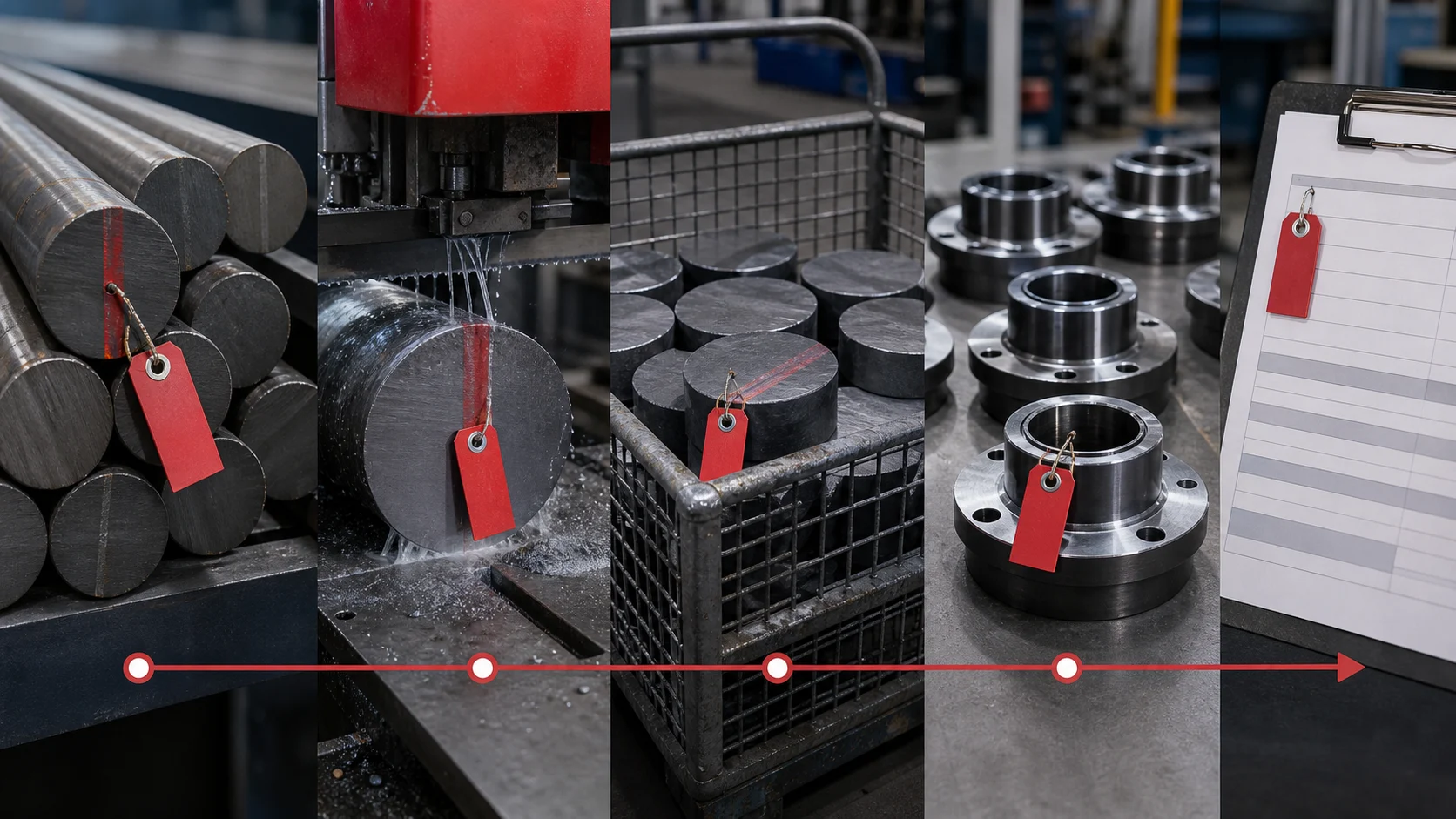
Material traceability fails when identity is separated from the physical material—not when a certificate is missing from a filing cabinet.
TL;DR
Material traceability is the ability to connect a physical item to the identity and records that govern its origin and processing. For metals, that often begins with a heat, melt, or lot number. For polymers, adhesives, coatings, electronics, and other inputs, it may use batch, lot, date-code, reel, or container identifiers.
A mill test report does not create traceability by itself. The shop must preserve the link from receipt to rack, remnant, sawed blank, work order, outside process, finished part, and shipment. Define the required granularity in the contract. Lot-level control may be sufficient for one product; serial-level material genealogy may be mandatory for another.
Traceability Is a Chain of Identity
NASA's quality-assurance handbook provides an example clause requiring certifications and test reports to be traceable through identifiers such as heat, lot, part, serial number, purchase order, or invoice from mill through finished-product delivery [1]. That language captures the central idea: the record must stay connected to the physical lineage.
NIST's manufacturing traceability work similarly describes traceability chains and linked event records used to establish provenance and pedigree across a supply chain [2].
The practical chain is:
supplier record → received material → storage location → issued quantity → cut pieces/remnant → work order → processing lots → finished items → shipment
Every arrow is a possible failure point.
Heat, Lot, Batch, and Serial Are Not Synonyms
| Identifier | Common use | What it typically groups | Buyer question |
|---|---|---|---|
| Heat or melt number | Primary metal production | Material produced from a defined melt or heat | Does the delivered product and report retain the original producer's identity? |
| Material lot | Metal, polymer, chemical, component, or converted product | Quantity grouped under a producer's lot definition | What event starts and closes the lot? |
| Batch | Mixed, processed, heat-treated, coated, or assembled material | Material processed together under defined conditions | Which inputs, parameters, equipment, and results belong to the batch? |
| Date code | Electronics and shelf-life-controlled materials | Production within a defined time coding system | Is the date code sufficient to identify the manufacturing lot? |
| Serial number | High-value or configuration-controlled items | One individually identified item | Is material and process genealogy maintained to each serial? |
| Work-order or traveler lot | Internal production control | Items released and routed together | Can it be reconciled to source material and outside-process lots? |
Do not invent a universal definition. The material producer, governing specification, customer requirement, and shop procedure determine what each identifier means.
The Cut-Piece Problem
Receiving is usually the easy part. Bars, sheets, plate, tube, wire, resin containers, or component reels arrive with labels and documents. Traceability is most vulnerable when material is divided.
For a sawed metal blank, a controlled method might:
- verify incoming identification against the purchase order and material report;
- create an internal material record tied to the source heat or lot;
- label the storage location and full-length stock;
- issue material to a work order;
- identify the cut blanks by tagged container, direct marking, or controlled segregation;
- identify and return any usable remnant;
- record quantity consumed, scrapped, and returned;
- preserve the relationship through outside processing and shipment.
The exact marking method depends on size, material, surface restrictions, cleanliness, and product risk. A tiny cut piece may be controlled by a container until it can be serialized. A large plate may carry direct identification. The system must prevent commingling and survive normal handling.
Certificate Review Is Separate From Identity Control
A material report should be checked against:
- producer and supplier;
- specification and revision where applicable;
- alloy, grade, type, or class;
- heat, melt, or lot identifier;
- product form and dimensions;
- chemical results;
- mechanical or physical results;
- heat treatment or condition;
- required test methods;
- acceptance limits;
- purchasing and part requirements.
JPL's current high-strength-fastener clause, for example, calls for the production lot, raw material heat lot or melt, material specification, producer, and required mechanical, chemical, dimensional, nondestructive, and metallurgical reports [3]. That is a product-specific clause, not a universal checklist, but it illustrates how identity and evidence work together.
A perfect report attached to the wrong bar is useless. A correctly identified bar with a report that does not meet the purchase specification is also unacceptable.
Outside Processing Creates New Genealogy
Heat treatment, plating, coating, conversion, testing, and other outside processes introduce new control numbers and process batches. Preserve both:
- the incoming material identity; and
- the outside processor's lot, batch, load, or certificate identity.
JPL's additive-manufacturing heat-treatment clause requires items such as a heat-treat control number, alloy, temper or strength designation, furnace identification, and time-temperature information [4]. The larger lesson is that the material genealogy grows as processing occurs. Replacing the heat number with a heat-treat batch number destroys lineage; linking the two extends it.
Choose the Required Granularity
| Risk or contract signal | Traceability approach to evaluate |
|---|---|
| Commodity noncritical item | Purchase and supplier lot may be sufficient if contract permits |
| Material properties are critical | Preserve original producer heat or lot through the finished lot |
| Multiple heats can enter one order | Segregate, identify, and report each heat or prohibit mixing |
| Destructive testing represents a batch | Define the batch represented by each specimen |
| Shelf-life material is mixed or cured | Link source lots, mix batch, operator, time, cure, and witness evidence |
| Serialized safety-critical assembly | Maintain component and material genealogy to each serial number |
| Rework or substitution occurs | Preserve original identity and record authorized disposition or change |
More granular traceability costs more. Require the level needed to support safety, regulation, contract, recall, investigation, and replacement—not a ceremonial “full traceability” note.
Traceability Audit Test
Select one shipped part and trace backward:
- finished part or serial to work order;
- work order to production and outside-process lots;
- production lot to issued material;
- issued material to receiving record;
- receiving record to producer certificate and purchase requirement.
Then select one incoming heat or lot and trace forward:
- current storage and remnants;
- open work orders;
- processed lots;
- shipped part numbers, lots, serials, and customers;
- scrap, return, or disposition.
Backward traceability supports root-cause investigation. Forward traceability defines containment. Both directions matter.
RFQ Requirements
State:
- the identifier that must be preserved;
- whether mixing heats or lots is prohibited;
- finished-part marking requirements;
- required certificate and actual-value reports;
- outside-process certificate expectations;
- serialization or lot granularity;
- record-retention duration;
- electronic format and shipment association;
- deviation and substitution approval;
- treatment of remnants, customer-supplied material, and scrap.
A Restrained Next Move
Draw the actual chain from receipt to shipment and mark where physical identity changes form. Qualify suppliers through the U.S. Manufacturing Directory by asking them to demonstrate one backward and one forward trace—not merely produce a sample certificate.
Related Articles
- Heat-Treatment Callouts: Condition, Hardness, Case Depth, and Test Evidence
- Outside-Process Tracking
- Quality History as a Reusable Manufacturing Asset
References
- National Aeronautics and Space Administration, NASA-HDBK-6025 — Guidelines for Quality Assurance and Quality Control of Program and Project Printed Products. Appendix G provides the raw-material-traceability example used here.
- National Institute of Standards and Technology, Supply Chain Traceability Manufacturing Meta-Framework.
- NASA Jet Propulsion Laboratory, QC11a — High Strength Fastener Requirements.
- NASA Jet Propulsion Laboratory, QC133 — Additive Manufacturing Heat Treat Requirements.