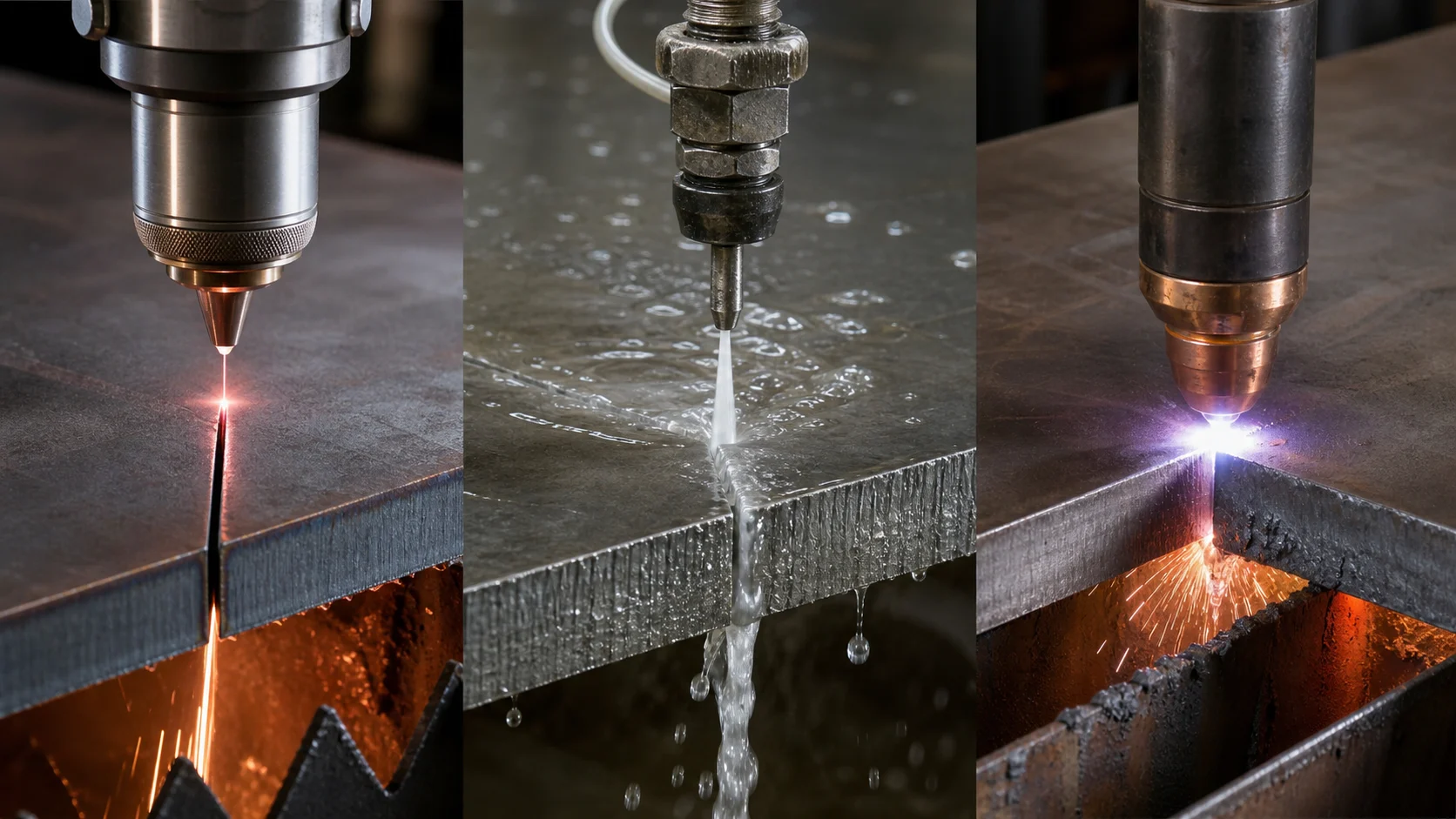
The right profile-cutting process is the one that produces an acceptable downstream part—not the one with the most impressive catalog tolerance.
TL;DR
Laser cutting is often strongest for fast, precise profiles in thin-to-moderate sheet and plate. Plasma is often economical and productive on electrically conductive metal, particularly where thicker sections and less exact edge requirements are acceptable. Abrasive waterjet cuts a broad range of materials without a thermal heat-affected zone and can be attractive for thick, heat-sensitive, reflective, layered, or nonmetallic material.
Those are screening rules, not quote rules. Actual capability depends on material, thickness, machine power, gas or abrasive system, pierce strategy, geometry, edge requirement, quantity, nested utilization, and downstream operations. Send all three candidate suppliers the same acceptance definition.
Three Different Removal Mechanisms
- Laser cutting concentrates optical energy to melt, vaporize, or react with material while an
assist gas clears the kerf.
- Plasma cutting uses a constricted high-energy arc and gas flow to melt and eject electrically
conductive material.
- Abrasive waterjet cutting accelerates water and abrasive through a small orifice and erodes
material.
Hypertherm's vendor-scoped process overview classifies laser and plasma as thermal processes and waterjet as erosive [1]. That physical distinction drives many of the downstream tradeoffs.
Process Comparison
| Decision factor | Laser | Abrasive waterjet | Plasma |
|---|---|---|---|
| Material | Many metals and selected nonmetals; machine/material compatibility matters | Very broad range of metals, stone, glass, composites, and other materials | Electrically conductive metals |
| Typical strength | Fast, accurate sheet/plate profiles and small features | Cold cutting, material breadth, thick sections, heat-sensitive work | Productive, economical metal cutting |
| Heat input | Yes | No conventional thermal HAZ | Yes |
| Kerf and feature detail | Often narrow and detailed | Controlled but affected by stream behavior and thickness | Generally broader and less detailed |
| Edge behavior | Striation, dross, oxide, recast, and heat effects vary | Taper, lag, striation, abrasive embedment, and pierce effects vary | Dross, bevel, heat effects, and arc-lag behavior vary |
| Thick material | Machine- and material-dependent | Often technically capable, with slower cut time | Strong within system capacity on conductive plate |
| Productivity | Often high on suitable thin/moderate material | Often slower as thickness and quality demand rise | Often high on suitable plate |
| Cost driver | Machine time, gas, power, setup, nesting | Machine time, abrasive, orifice/nozzle wear, water handling | Consumables, power/gas, machine time, cleanup |
Hypertherm's published selection guide describes laser as generally suited to thinner or tight-tolerance work, plasma to conductive metal in its effective thickness range, and waterjet to thick or varied materials and applications that cannot accept a heat-affected zone [2]. Treat those as manufacturer guidance; obtain process-specific sample cuts for critical work.
Start With the Material Stack
Tell the supplier:
- exact material specification and condition;
- thickness and thickness tolerance;
- coating, film, cladding, laminate, adhesive, or scale;
- reflective or reactive material concerns;
- grain or fiber orientation;
- whether the cut crosses dissimilar layers;
- required material certification and traceability; and
- whether heat, water, abrasive, or contamination is prohibited.
Waterjet's “cuts almost anything” reputation does not mean every material can be pierced without damage. Laminates, brittle materials, trapped cavities, tempered materials, and contamination- sensitive products need a qualified entry and fixturing strategy.
Define the Edge You Can Accept
Instead of “laser-quality edge,” specify:
- profile tolerance and datum relationship;
- hole-size and feature limits;
- maximum taper or bevel;
- burr and dross acceptance;
- striation or roughness where functional;
- heat tint, oxide, recast, or metallurgical restrictions;
- corner, lead-in, and pierce witness rules;
- edge preparation for welding or coating;
- whether tabs or microjoints are allowed; and
- which edges receive machining.
Flow, a waterjet OEM, describes abrasive waterjet as a cold-cutting process without a conventional heat-affected zone [3]. That can preserve bulk material properties near the edge, but it does not automatically guarantee final tolerance, fatigue performance, cleanliness, or freedom from embedded abrasive. Those outcomes still require acceptance criteria.
The Heat-Affected-Zone Question
Ask what the downstream product actually needs:
- Is the cut edge highly stressed?
- Will it be welded?
- Will it be bent close to the edge?
- Will the edge receive heat treatment?
- Must oxide be removed before coating?
- Is metallurgical testing required?
- Will final machining remove the affected material?
A thermal process may be fully acceptable when the edge is noncritical or receives machining. A waterjet premium may be justified when heat input creates a real failure mode. “No HAZ” should be a functional requirement, not a reflex.
Geometry Changes the Answer
Screen the drawing for:
- small holes relative to thickness;
- narrow webs and slots;
- dense pierce count;
- sharp internal corners;
- long unsupported contours;
- common-line cutting;
- tip-up risk;
- bevels;
- marking or etching;
- large envelope;
- multi-axis edges; and
- nested material utilization.
One process may cut the outside profile economically while another operation produces precision bores, threads, countersinks, seals, or datums. Quote the finished route rather than comparing raw cutting rates.
Sample-Cut Qualification
For high-risk work, provide representative material and request:
- the intended production machine and process;
- representative pierces, corners, small features, and long cuts;
- the proposed quality/speed setting;
- dimensional results in the defined condition;
- edge and metallurgical evaluation where required;
- expected secondary operations; and
- a retained sample tied to the approved route.
Do not qualify a polished showcase sample if production will use a different machine, head, consumable, or speed setting.
Safety and Environmental Boundaries
Industrial laser equipment requires appropriate enclosure, guarding, interlocks, emergency systems, and a laser-safety program according to the applicable system and workplace [4]. OSHA also identifies plasma-cutting exposures such as fumes, radiation, hot metal, electricity, and noise [5]. Waterjet systems introduce their own high-pressure, noise, abrasive, handling, and waste controls. Supplier selection should include safe, compliant process execution; this article is not a machine-safety procedure.
RFQ Checklist
- Material, condition, thickness, coating, and traceability are defined.
- CAD and drawing share one revision.
- Profile, hole, edge, and cosmetic acceptance are explicit.
- Thermal or contamination restrictions have a functional basis.
- Lead-ins, pierces, tabs, and nesting witness marks are controlled.
- Downstream bending, welding, machining, heat treat, and coating are disclosed.
- Quantity, lot size, repeat demand, and remnant ownership are stated.
- Packaging protects cut edges and flatness.
- Sample-cut approval is required where process risk warrants it.
Decision Rule
Choose laser when its speed, detail, and edge quality meet the complete part requirement. Choose plasma when conductive-metal productivity and economics matter more than fine-detail edge quality. Choose waterjet when material breadth, thickness, or avoidance of thermal effects justifies its slower and often more consumable-intensive route. Then validate the actual supplier, machine, and sample—not the generic process label. Build the first candidate set through the U.S. Manufacturing Directory.
Related Articles
- Sheet Metal Bending
- Anodizing, Passivation, Plating, and Powder Coating
- Build a U.S. Manufacturer Shortlist
References
- Hypertherm, Cutting Process Overview. Vendor-scoped technical overview.
- Hypertherm, Choosing a Cutting Process. Vendor-scoped screening guidance.
- Flow International, Standard Waterjet Cutting. OEM description of its waterjet process.
- Occupational Safety and Health Administration, Laser Safety in Semiconductor Operations.
- Occupational Safety and Health Administration, Hot Work and Plasma Arc Cutting Hazards.