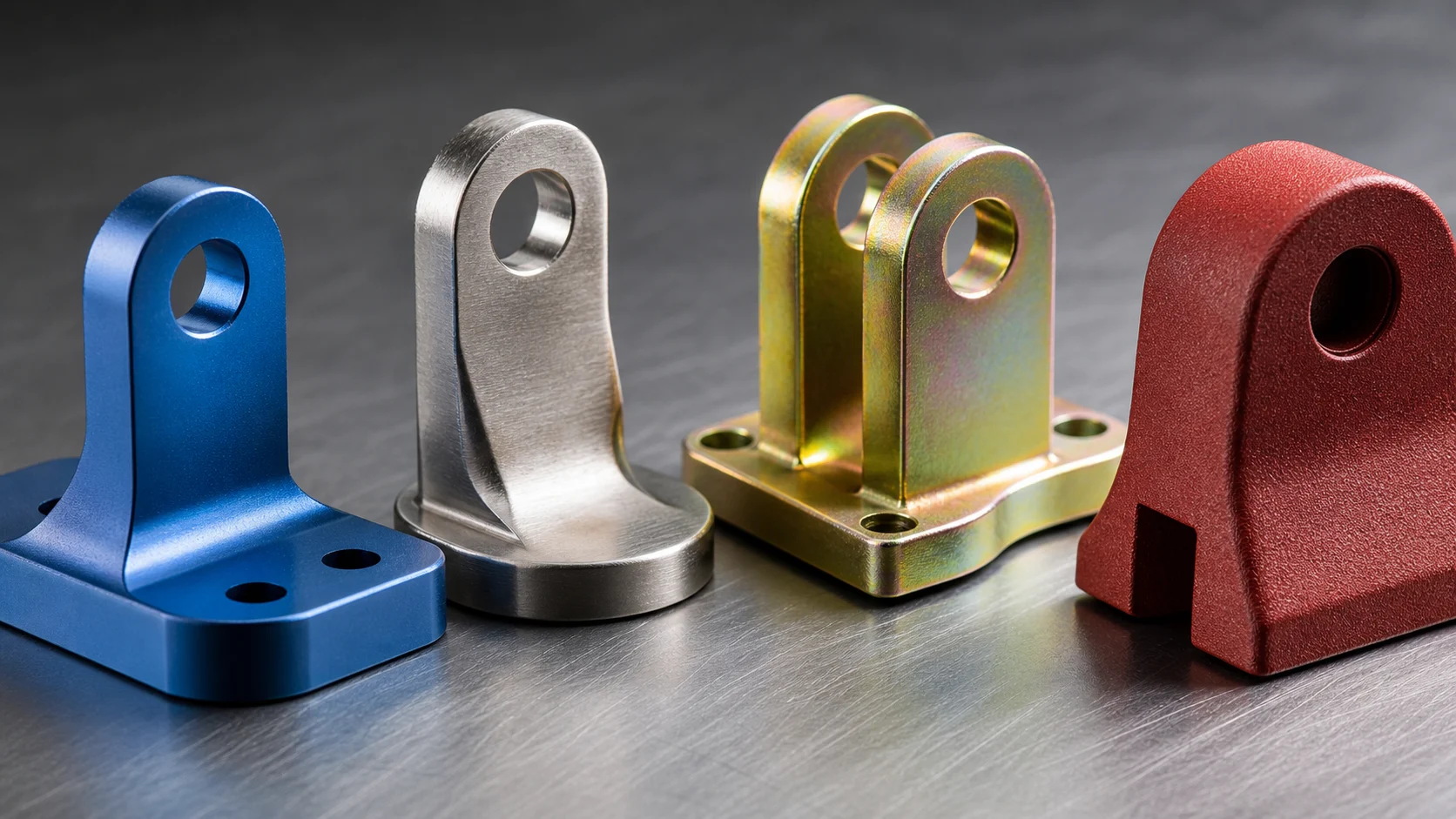
Anodizing, passivation, plating, and powder coating are not interchangeable finishes. They modify or add to different substrates for different functional outcomes.
TL;DR
Anodizing electrochemically forms an oxide coating on aluminum and aluminum alloys. Passivation of corrosion-resistant steel removes free iron or less-noble surface contamination under the specified process. Electroplating deposits a metal coating for properties such as corrosion, wear, friction, conductivity, or appearance. Powder coating applies and cures an organic coating that can provide color, coverage, and environmental protection.
Choose by substrate and function first. Then specify the governing standard, type or class, thickness, pretreatment, masking, color or appearance, dimensional allowance, post-treatment, test evidence, and approved processor. A color name is not a finish specification.
Fast Comparison
| Process | Typical substrate | What happens at the surface | Common reasons to use it |
|---|---|---|---|
| Anodizing | Aluminum and aluminum alloys | Controlled electrochemical oxide grows at and into the surface | Corrosion protection, wear behavior, appearance, dielectric behavior |
| Passivation | Corrosion-resistant steels | Cleaning and chemical treatment remove free iron or contaminants | Restore or assure a passive surface after fabrication |
| Electroplating | Ferrous or nonferrous basis material | Metal is deposited on the surface | Corrosion, wear, friction, conductivity, solderability, appearance |
| Powder coating | Many properly prepared metals | Polymer powder is applied and cured into a film | Color, coverage, environmental protection, durable exterior finish |
These are families, not single recipes. The applicable specification and material matter. Chemical conversion coating is another distinct family; MIL-DTL-5541 covers conversion coatings formed by reaction with aluminum and aluminum-alloy surfaces [4].
Anodizing
The active U.S. defense specification MIL-PRF-8625 covers six types and two classes of electrolytically formed anodic coatings on aluminum and aluminum alloys for nonarchitectural applications [1].
Buyer decisions include:
- alloy and temper;
- anodize type and class;
- coating thickness;
- dyed or nondyed condition;
- sealing;
- wear and corrosion requirements;
- electrical contact areas;
- masking and plugged holes;
- dimensional effect;
- cosmetic acceptance and color range;
- rack locations.
Anodizing is not paint. Because the oxide develops from the aluminum surface, dimensional planning must follow the specified process and thickness rather than treating the finish as an arbitrary film added afterward.
Passivation
SAE AMS2700 defines engineering requirements for a process intended to remove free iron or other less-noble contaminants from corrosion-resistant steel surfaces [2]. Passivation does not turn carbon steel into stainless steel, deposit chromium metal, or erase heat tint, scale, poor welding practice, embedded abrasive, or incorrect alloy.
Specify:
- applicable material and condition;
- governing passivation standard and revision;
- cleaning and precondition requirements;
- treatment type where required;
- parts or surfaces included;
- test and sampling requirement;
- handling after treatment.
The process route may need prior cleaning, descaling, pickling, or mechanical finishing. Do not use the single word “passivate” to hide the incoming-surface condition.
Electroplating
EPA describes electroplating as electrodeposition of a surface coating to provide functions such as corrosion protection, wear or erosion resistance, antifriction characteristics, or decoration [3]. The deposited metal, underplate, thickness, basis material, and post-treatment determine performance.
Common buyer variables include:
- plating metal and governing specification;
- basis material and hardness;
- service condition or class;
- minimum and maximum local thickness;
- significant surfaces;
- underplate;
- masking;
- hydrogen-embrittlement relief where applicable;
- chromate or other post-treatment;
- adhesion, corrosion, hardness, or porosity testing;
- electrical or solderability requirements.
Threads, bores, sharp edges, recesses, and rack-contact areas do not receive uniform deposition. Ask the processor how geometry affects thickness distribution.
Powder Coating
Powder coating depends on substrate preparation, powder chemistry, application, grounding, coverage, cure, and handling. Define:
- substrate and pretreatment;
- powder manufacturer and product or qualified equivalent;
- color standard and acceptable variation;
- gloss and texture;
- film-thickness range;
- masked surfaces and plug requirements;
- edge and recess coverage;
- cure verification;
- adhesion, impact, corrosion, or weathering tests;
- cosmetic viewing conditions and defect limits.
Avoid controlling function through a color swatch alone. Two powders with similar appearance can have different chemistry, cure, durability, and repair behavior.
Functional Selection Matrix
| Requirement | Process to investigate | Important qualification |
|---|---|---|
| Aluminum corrosion protection with controlled oxide | Anodizing | Alloy, type, class, thickness, seal, electrical needs |
| Stainless surface contamination after fabrication | Passivation | Alloy, incoming condition, cleaning, treatment, test |
| Sacrificial corrosion protection on steel | Zinc or other specified plating system | Service class, thickness distribution, post-treatment |
| Hard wear surface on selected geometry | Hard anodize or engineered plating | Substrate, thickness, dimensional impact, tribology |
| Thick colored exterior film | Powder coating | Pretreatment, chemistry, cure, UV and corrosion exposure |
| Conductive contact area alongside protective finish | Selective process and masking | Contact resistance, mask boundary, inspection |
This is a screening table, not a design rule. Corrosion environment, mating materials, fatigue, temperature, electrical behavior, food or medical contact, and regulatory constraints can change the answer.
Drawing and RFQ Checklist
- Substrate alloy, grade, and condition
- Governing finish specification and revision
- Process type, class, grade, or service condition
- Required thickness and where it applies
- Significant surfaces
- Masking, plugging, threads, bores, and contact areas
- Pre-finish dimensions and allowance strategy
- Color, gloss, texture, and viewing criteria
- Pretreatment and post-treatment
- Hydrogen-relief requirements where applicable
- Adhesion, corrosion, wear, electrical, or appearance tests
- Lot traceability and certificate content
- Approved processor or accreditation flowdown
- Packaging and protection after finish
Processor Qualification
Metal finishing can involve regulated air emissions and wastewater. EPA's electroplating and metal-finishing rules cover relevant process categories and pollutants [3]. Buyers should verify that processors operate under applicable environmental and safety controls without trying to perform a regulatory audit from a purchasing checklist.
Also verify:
- scope of process approval;
- tank or oven capacity;
- alloy and chemistry compatibility;
- bath and cure control;
- masking competence;
- test capability;
- lot identification;
- rework limits;
- change notification;
- handling and packaging.
A Restrained Next Move
Replace the finish nickname on the RFQ with substrate, function, governing specification, thickness, masking, and acceptance evidence. Then use the U.S. Manufacturing Directory to identify manufacturers and processors whose actual scope matches the finish.
Related Articles
References
- Defense Logistics Agency, MIL-PRF-8625 — Anodic Coatings for Aluminum and Aluminum Alloy.
- SAE International, AMS2700 — Passivation of Corrosion Resistant Steels.
- U.S. Environmental Protection Agency, Electroplating Effluent Guidelines.
- Defense Logistics Agency, MIL-DTL-5541 — Chemical Conversion Coatings on Aluminum and Aluminum Alloys. Used to distinguish conversion coating from anodizing.