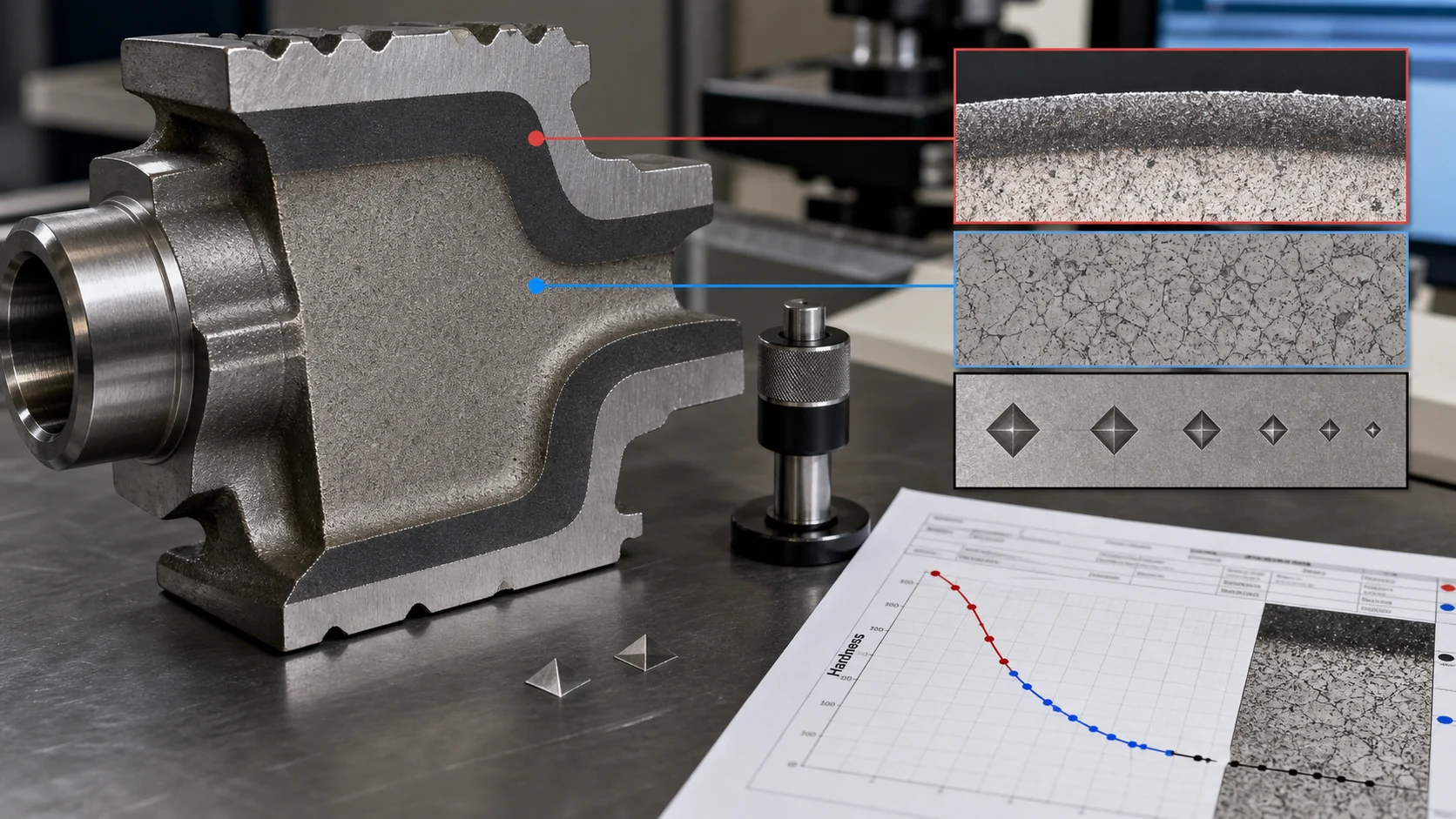
A heat-treatment callout must define the finished metallurgical condition and acceptance evidence—not merely name a familiar process.
TL;DR
A complete heat-treatment requirement identifies the material and incoming condition, governing process or material specification and revision, required final condition, hardness range, case depth definition when applicable, test method and location, lot definition, sampling, distortion or machining sequence, required records, and rules for reprocessing.
Do not use hardness as a universal substitute for material condition. Do not state “case hardened” without effective or total case depth and a measurement definition. Require evidence that can be connected to the actual lot, furnace cycle, and accepted parts.
Specify the Result Before the Furnace Route
Heat treatment changes material properties through controlled thermal cycles. The correct route depends on alloy, product form, prior condition, geometry, furnace equipment, atmosphere, quench, part loading, and the property required at the end.
SAE AMS-H-6875 covers process requirements for heat treatment of specified classes of steel and includes equipment, procedures, temperatures, and tests within its stated scope [1]. It is not a generic instruction for every alloy. Aluminum, nickel, titanium, tool steels, castings, and customer-controlled products can require different material and process specifications.
Minimum Heat-Treatment Callout
| Element | Required definition |
|---|---|
| Material | Alloy, grade, product specification, and allowed substitutions |
| Incoming condition | Annealed, normalized, solution treated, cold worked, prehardened, or other state |
| Governing document | Process or material specification and revision |
| Required process | Only where the route itself is controlled |
| Final condition | Temper, strength class, microstructure, or named condition |
| Hardness | Scale, range, location, surface preparation, and timing |
| Case | Process type, effective or total depth, threshold, location, and method |
| Mechanical properties | Tensile, yield, elongation, impact, or other required result |
| Geometry | Distortion limits, stock allowance, masking, and final-machining sequence |
| Lot and sampling | What constitutes a lot and how tests represent it |
| Evidence | Certificate, furnace chart, actual results, coupons, micrographs, or raw data |
| Reprocessing | Allowed cycles, authorization, retest, and disclosure |
Incoming and Final Condition Must Both Be Known
The same alloy designation can arrive in different conditions and respond differently. State:
- raw-material specification;
- product form and size;
- melt, heat, or lot identity;
- prior processing if it affects response;
- incoming hardness or condition where necessary;
- required final condition; and
- whether material certification alone or independent verification is required.
If the heat treater receives only a part number and desired hardness, it may not have enough information to validate the cycle or even confirm that the requested result is metallurgically reasonable.
Hardness Is a Measurement Requirement
“Harden to 58” omits the scale, tolerance, test location, surface condition, and method. A useful hardness requirement answers:
- Which scale and test standard apply?
- Is the range a product requirement or an informational target?
- Where on the part or coupon is testing permitted?
- Must decarburized, plated, curved, thin, or ground surfaces be treated specially?
- How many readings represent a part and a lot?
- Are conversions between hardness scales allowed?
- Are indentations acceptable on the product?
- When in the manufacturing sequence is hardness verified?
If hardness is used as evidence for a strength or metallurgical condition, confirm that the governing specification permits that relationship.
Case Depth Requires a Definition
Case-hardening processes can include carburizing, carbonitriding, nitriding, induction hardening, and other routes. “Case depth 0.030 inch” is incomplete.
Define:
- process or allowed processes;
- effective case depth or total case depth;
- hardness threshold used to define effective depth;
- test method;
- measurement location and section orientation;
- minimum, maximum, or range;
- core hardness;
- surface hardness;
- areas to be hardened or protected;
- allowance for grinding after treatment; and
- coupon relationship to the production part.
A depth measured on a separate coupon may not represent a thick-to-thin transition, tooth root, corner, bore, or shielded area unless the coupon and process plan are qualified to do so.
Pyrometry Controls the Thermal System
SAE AMS2750H addresses pyrometric requirements for thermal-processing equipment, including temperature sensors, instrumentation, system accuracy tests, correction factors, and temperature uniformity surveys [2]. Requiring AMS2750 does not by itself define the correct treatment cycle or final properties. It controls aspects of the measurement and furnace system used to execute the applicable process specification.
When the contract requires a furnace class, instrumentation type, survey interval, load sensors, or recording detail, flow those requirements explicitly and verify that the supplier's scope covers them.
Plan Geometry Around Thermal Movement
Heat treatment can change size, straightness, flatness, roundness, and residual stress. The engineering package should define:
- features machined before treatment;
- stock retained for finish grinding or machining;
- threads, sharp corners, thin sections, and mixed masses at risk;
- areas requiring copper plate, stop-off, masking, or atmosphere protection;
- straightening permission and limits;
- stress relief sequence;
- dimensional inspection before and after treatment; and
- final acceptance state.
Do not demand a tight finished dimension in the pre-heat-treat condition and then leave no allowance to recover it.
Evidence Should Close the Requirement
JPL's current additive-manufacturing heat-treat clause illustrates a rigorous reporting set: control number, specification, purchase order, part and alloy, temper or strength designation, quantity, furnace identity, time-temperature-atmosphere profiles, load thermocouple location, and specified charts [3]. That clause is contract-specific, but it shows the difference between a generic certificate and usable process evidence.
Choose evidence based on product risk:
| Evidence level | Typical content |
|---|---|
| Basic certification | Supplier, PO, part, lot, process/specification, quantity, conformance statement |
| Result certification | Basic data plus actual hardness, case, or mechanical results |
| Cycle evidence | Furnace/load identity, dates, cycle parameters, atmosphere, quench, charts |
| Qualification package | Procedures, equipment status, personnel, coupons, microstructure, full test data |
The certificate must connect the process lot back to material identity and forward to the parts accepted.
RFQ and Purchase-Order Checklist
- Material and incoming condition are unambiguous.
- The governing specification and revision are supplied or accessible.
- Final condition and actual acceptance properties are stated.
- Hardness includes scale, range, location, method, and sampling.
- Case depth includes definition, threshold, location, and method.
- Lot definition and coupon representation are controlled.
- Pre- and post-treatment machining sequence is clear.
- Distortion, straightening, masking, and surface protection are addressed.
- Approved facility and applicable process scope are verified.
- Required certificate, actual results, charts, and test artifacts are listed.
- Deviations and reprocessing require authorization.
Use the U.S. Manufacturing Directory to identify candidate heat treaters, then verify the exact facility, furnace class, process scope, and approval status.
Related Articles
References
- SAE International, AMS-H-6875 — Heat Treatment of Steel, Process for.
- SAE International, AMS2750H — Pyrometry.
- NASA Jet Propulsion Laboratory, QC133 — Additive Manufacturing Heat Treat Requirements. Used as a contract-specific reporting example, not a universal requirement.