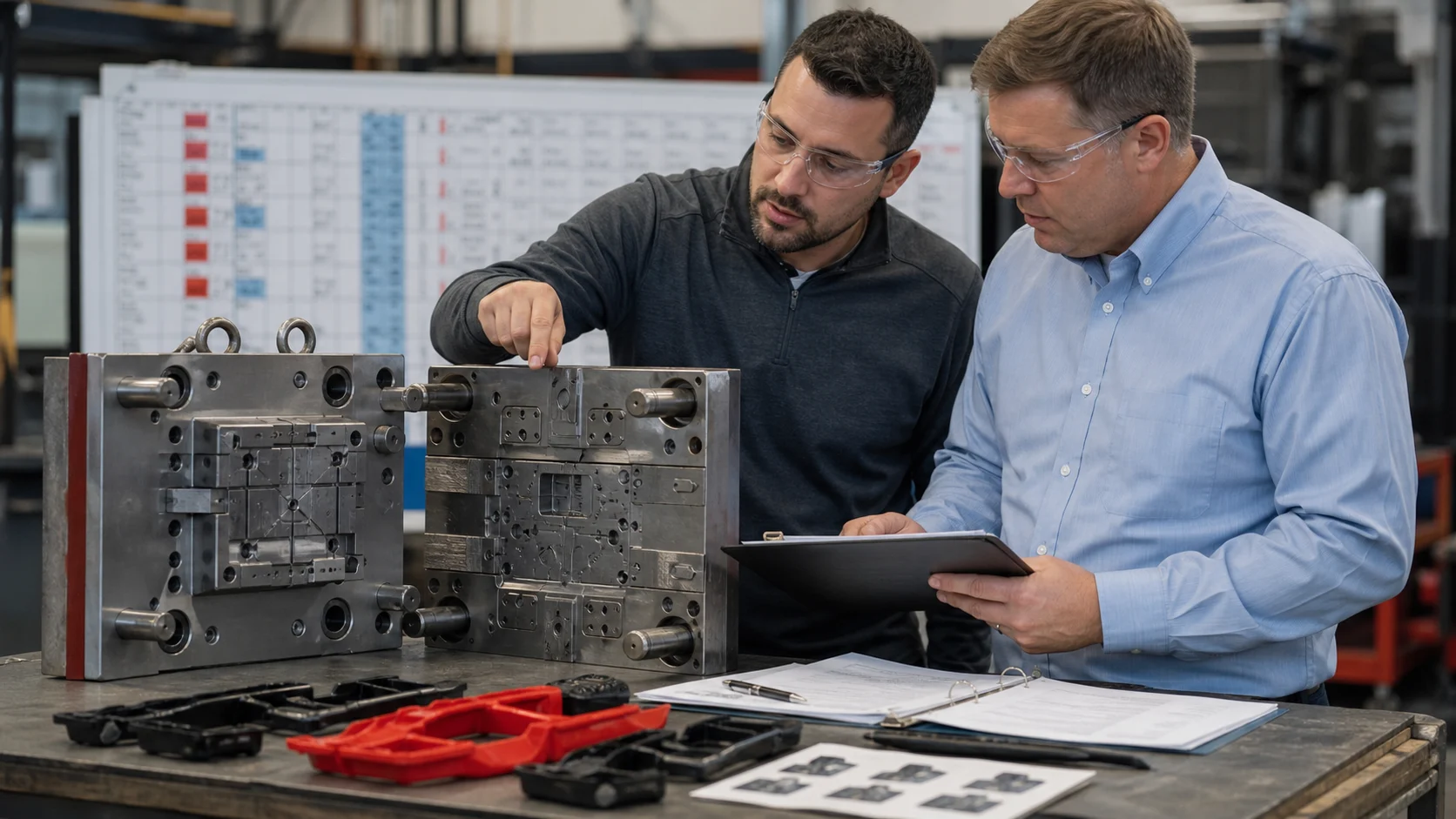
An injection molding supplier is not qualified by press tonnage alone. The mold, resin, process window, automation, validation, maintenance, and release pattern must work as one production system.
TL;DR
Select an injection molder by the complete production system: resin handling, mold design and ownership, compatible presses, process development, automation, secondary operations, inspection, maintenance, available capacity, and change control.
NIST treats injection molding as a unit-manufacturing process whose performance depends on defined process inputs and production conditions [3]. Supplier qualification should therefore evaluate the controlled process, not a display sample or machine list.
Require clarity about who owns the mold, tool data, spare components, fixtures, and validation records; where the tool will be stored; who may modify it; and what happens if production moves. Validate the process under representative production conditions rather than approving handpicked parts from an undefined setup.
The Mold and Press Are One System
OSHA describes thermoplastic injection molding as melting pellets, injecting the material into a two-half mold held closed by platens, cooling the material, opening the mold, and removing the part [1]. That simple sequence contains the core supplier-selection problem: resin, machine, mold, cooling, handling, and people all affect the outcome.
Press tonnage is only one boundary. A credible fit also considers:
- shot size and residence-time range;
- tie-bar spacing and platen dimensions;
- mold thickness and daylight;
- injection pressure and rate;
- clamp behavior;
- hydraulic or electric auxiliary needs;
- hot-runner controls;
- core pulls and unscrewing;
- cooling-water capacity and quality;
- robot and downstream automation;
- part-removal and cavity-separation method.
Ask which specific press family the tool is intended to run in and what equivalent alternatives exist. “Up to 500 tons” is not a process plan.
Supplier-Selection Matrix
| Dimension | Evidence to request | Failure prevented |
|---|---|---|
| Resin control | Approved grade, supplier, drying, storage, regrind, colorant, lot traceability | Material drift, moisture defects, substitution |
| Tooling | Design review, ownership, build location, steel, cavities, spares, maintenance | Tool dispute, weak transferability, unplanned downtime |
| Machine fit | Named press range and interface requirements | Tool that cannot run as validated |
| Process development | Defined parameters, process window, cavity balance, startup and shutdown | “Golden settings” without robustness |
| Capacity | Demonstrated cycle, cavitation, uptime, shifts, competing load, maintenance | Awarding annual volume the cell cannot supply |
| Validation | Representative run, samples, measurement, capability, approvals | Approving samples that do not represent production |
| Secondary work | Degating, decoration, welding, assembly, testing, packaging | Hidden handoffs and uncontrolled added operations |
| Change control | Resin, source, tool, press, site, process, automation, inspection triggers | Silent changes after approval |
Tool Ownership Must Be Written
A purchase order that says “customer-owned tool” leaves major questions unanswered:
- Who owns the mold design and native files?
- Who owns inserts, hot-runner components, spare details, fixtures, gages, and robots?
- Can the supplier use the tool for another customer?
- Where is it stored and how is it identified?
- Who pays for preventive maintenance and normal wear?
- Who approves repairs and design changes?
- What condition report is required?
- What insurance and property controls apply?
- Can the tool be moved, and what documentation must move with it?
- Who owns learning from process development?
Create a tooling schedule with unique identifiers and acceptance criteria. Separate tool purchase from part purchase. If the supplier finances or amortizes the tool, define when ownership transfers and what balance remains if the program ends.
Resin Management Is Production Control
The RFQ should identify:
- base resin and governing specification;
- grade, filler, reinforcement, and color;
- approved manufacturer or equivalent policy;
- virgin and regrind limits;
- drying and moisture requirements;
- lot and certificate requirements;
- shelf-life or storage constraints;
- contamination and cleanout rules;
- customer-supplied material terms.
Material behavior can change fill, shrinkage, warpage, surface appearance, strength, and tool wear. Do not approve an unspecified “equivalent” from visual samples.
Validation Must Represent the Intended Cell
Define what production approval means before tool completion.
Tool qualification
Confirms that the mold operates, fills, cools, ejects, and produces the required features without unresolved tool defects.
Process development
Establishes a repeatable process window rather than one narrow set of operator-tuned conditions. Record the parameters that materially affect the part.
Product verification
Confirms dimensional, visual, material, functional, and assembly requirements using the defined sampling and measurement plan.
Production validation
Uses the intended mold, press or qualified equivalent, automation, material, operators, cycle, cavities, inspection, and packaging at a representative production rate.
For automotive work, the requested PPAP level and customer-specific requirements define the submission. For medical devices, validation obligations can be regulatory and product-specific. Do not copy one industry's package into another without establishing the governing requirement.
Capacity Is More Than Cycle Time
Theoretical annual output is:
available scheduled seconds × good cavities per cycle ÷ demonstrated cycle seconds
Real output must account for:
- changeovers and color changes;
- startup scrap;
- planned maintenance;
- unscheduled downtime;
- cavity disablement;
- inspection and test holds;
- secondary-operation bottlenecks;
- labor and material availability;
- customer release variability.
Ask for capacity at the constraint. A four-cavity mold running in a fast press does not help if the leak-test station supports half the rate.
Maintenance and Transfer Readiness
Tool maintenance should record:
- shot count or cycles;
- cleaning and lubrication;
- wear measurements;
- vents, gates, ejectors, slides, and cooling-circuit condition;
- repairs and replaced components;
- current cavity status;
- open concerns;
- photographs and storage condition.
OSHA's injection-molding guidance addresses guards, interlocks, operator gates, and lockout/tagout for servicing [2]. Buyers should verify that the supplier has a working safety and maintenance system, not prescribe machine-safety methods through an article.
For transfer readiness, maintain:
- native and released mold design;
- bill of materials;
- standard component list;
- electrical, hydraulic, pneumatic, and water schematics;
- process setup and validated window;
- maintenance and repair history;
- approved samples and inspection plan;
- spare parts;
- lifting and handling requirements.
Supplier Audit Questions
- Which presses can run this mold, and which press will support validation?
- How are resin identity, drying, contamination, and regrind controlled?
- Who designs, builds, accepts, owns, maintains, and may modify the mold?
- How are cavities identified in inspection and traceability?
- What parameters define the approved process window?
- How are startup, shutdown, and process interruptions controlled?
- What is the demonstrated rate at the complete-cell bottleneck?
- Which changes require customer notification or revalidation?
- How will defects be contained back to resin lot, cavity, press, shift, and process batch?
- What package allows the program to transfer without reverse engineering?
A Restrained Next Move
Create separate checklists for the part supplier, mold asset, and validated production cell. Use the U.S. Manufacturing Directory to identify molding candidates, or Intelligent Sourcing when resin, tooling, or production-volume assumptions are not ready for a full RFQ.
Related Articles
- Supplier Quality Audit: What a Certificate Cannot Tell You
- Inspection Planning
- Material Traceability
References
- Occupational Safety and Health Administration, Horizontal Injection Molding Machines.
- Occupational Safety and Health Administration, Plastics Machinery Machine-Guarding eTool.
- National Institute of Standards and Technology, Energy Performance Evaluation of Unit Manufacturing Processes: Injection Molding. Used to establish injection molding as a controlled unit-manufacturing process, not to prescribe a supplier's parameters.